



Usage-Based Pricing vs Per-Seat: Which Wins in 2026?

 Jul 17,2026
  By Muhammad Danish
 Table of Contents
Every SaaS pricing conversation eventually lands on the same fork in the road: usage-based pricing or per-seat pricing. Do you charge for what people use, or do you charge for who’s logging in? That single decision shapes revenue predictability, customer trust, and how fast your product actually grows.
This model has been the loudest trend in SaaS for the past few years, and for good reason. It aligns cost with value, it removes the friction of “will this new hire blow our budget,” and it lets customers start small and scale naturally. But per-seat pricing hasn’t gone anywhere either. It’s simple, predictable, and still the default for entire categories of software.
At Cloud Fold Studio, we’ve watched founders agonize over this choice, and the honest answer is that neither model is universally better. The right one depends on how your product delivers value, who’s buying it, and how you want your revenue to behave as you scale. This article breaks down both approaches, when each one wins, and how to think through the decision for your own business in 2026.
What Usage-Based Pricing Actually Means
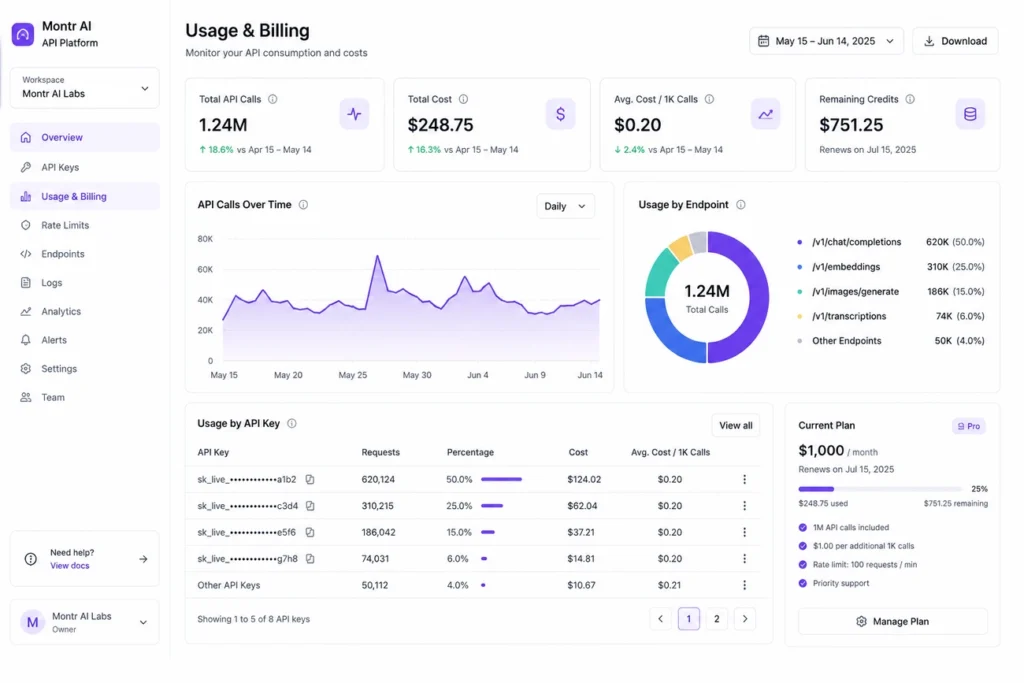
Usage-based pricing charges customers according to how much of the product they consume. That could mean API calls, storage volume, active workflows, messages sent, or compute time. Instead of a flat monthly fee, the bill moves with actual activity.
The appeal is straightforward. A small team paying for a handful of API calls a month shouldn’t pay the same as an enterprise running millions of requests through the same platform. Usage-based pricing lets the invoice reflect the value received, which makes it easier to land small customers and expand naturally as they grow into the product.
It also removes a common objection during sales conversations. When a prospect isn’t sure how heavily they’ll use a tool, a usage-based model lets them start cheap and pay more only once the product proves itself. That lower-risk entry point has made usage-based pricing especially popular among infrastructure, developer tools, and AI-native SaaS companies, where consumption can vary wildly between customers.
What Per-Seat Pricing Actually Means
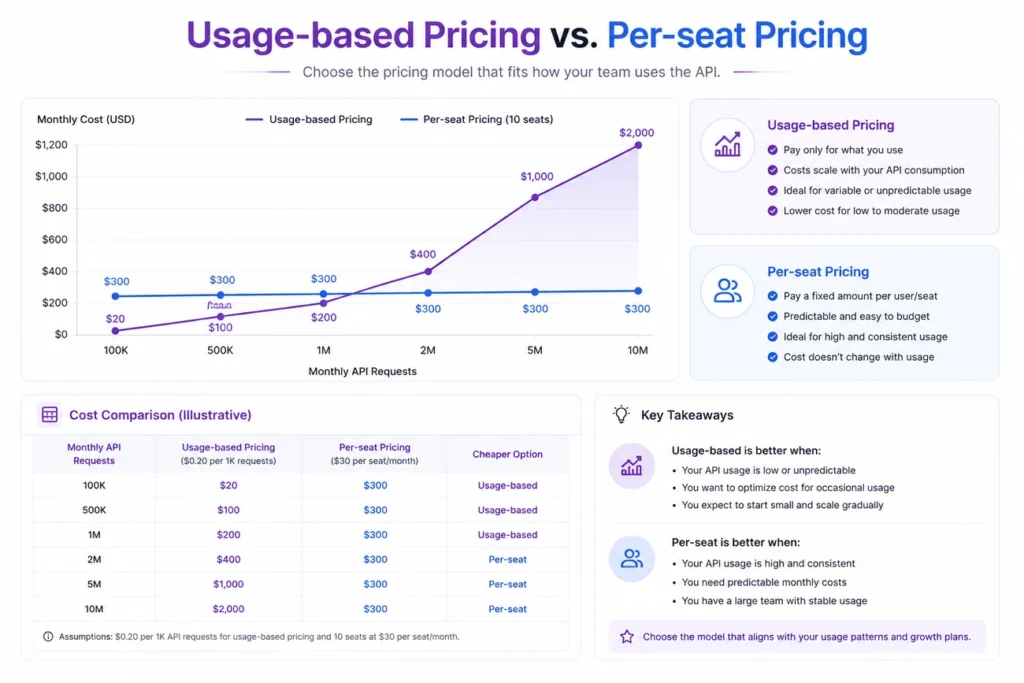
Per-seat pricing charges based on the number of users with access to the product, typically billed monthly or annually per license. It’s the model most people grew up with in SaaS: one price per person, regardless of how much or how little that person actually uses the tool.
The strength of per-seat pricing is predictability. Finance teams can forecast costs months in advance because the bill is tied to headcount, not behavior. For software where usage is fairly uniform across users, like project management tools or internal communication platforms, per-seat pricing maps cleanly onto how the product is actually adopted.
It also simplifies procurement. Buyers understand exactly what they’re paying for and can budget accordingly, without needing to model out consumption scenarios or worry about a surprise invoice at the end of the month. That predictability is a major reason per-seat pricing remains dominant in categories like CRM, HR software, and collaboration tools.
Where Usage-Based Pricing Wins
Usage-based pricing tends to win when value is tightly correlated with consumption rather than headcount. If one customer’s usage is ten times another’s, and that usage actually reflects ten times the value received, a flat per-seat fee leaves money on the table for high-usage customers and overcharges low-usage ones.
This model also shines in products where the “user” isn’t even a person. API platforms, data pipelines, and AI agents often don’t have a natural seat to charge for. A workflow automation tool that runs unattended doesn’t have a human sitting at a desk using it eight hours a day, so pricing by seat makes little sense. Usage-based pricing solves that mismatch directly.
There’s also a growth argument. This pricing approach tends to expand revenue automatically as customers succeed. A customer who onboards more data, runs more automations, or processes more transactions pays more, without anyone needing to run an upsell conversation. That built-in expansion is a major reason usage-based pricing has become the default for many AI-native SaaS products, where consumption scales directly with the value customers extract from the model.
Where Per-Seat Pricing Wins
Per-seat pricing wins when usage is fairly consistent across users and the product’s value comes from access rather than volume. A design tool, a note-taking app, or an internal wiki delivers roughly the same value whether someone opens it five times a day or fifty. Charging by consumption in that case would just add complexity without capturing more value.
It also wins on budget certainty, which matters enormously to larger buyers. Enterprise finance teams often prefer a known, fixed cost they can plan around over a variable bill that could spike unexpectedly. For compliance-ready SaaS sold into regulated industries, that predictability can be a deciding factor in procurement, even if a usage-based model would technically be cheaper in a typical month.
Per-seat pricing is also easier to sell internally. A department head asking for budget approval can point to a simple number multiplied by headcount. That’s a much easier conversation than justifying a variable line item that depends on how the tool gets used, especially in organizations still building out the internal muscle to track and manage SaaS sprawl.
Hybrid Models: The Middle Ground Most Companies Land On
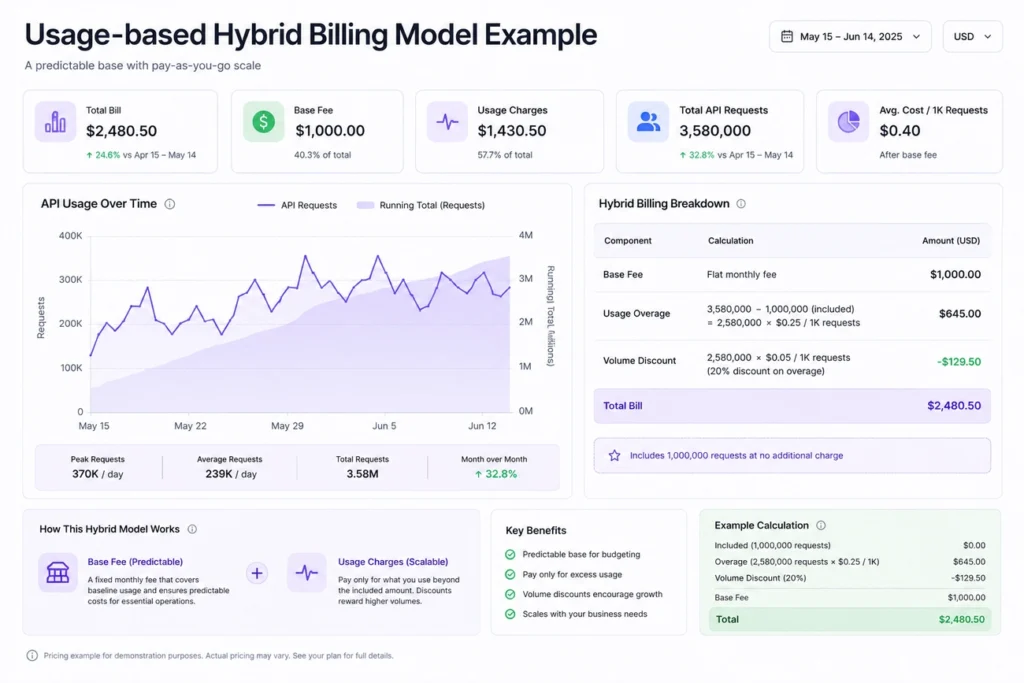
In practice, most successful SaaS companies don’t pick one model and stop there. They land on a hybrid: a base seat fee that covers a core allotment of usage, with additional consumption billed on top once customers exceed it.
This structure captures the best of both worlds. The seat component gives finance teams a predictable floor to budget around, while the usage component lets revenue expand naturally as customers grow. According to OpenView’s SaaS benchmarking research, hybrid pricing structures have become increasingly common among fast-growing SaaS companies precisely because they balance predictability with expansion. It also protects against the biggest risk of pure usage-based pricing: unpredictable bills that erode customer trust and trigger churn when a surprise invoice lands.
Hybrid pricing does add complexity to the billing stack. Metering usage accurately, displaying it transparently to customers, and reconciling it against seats requires more engineering investment than a flat per-seat fee. But for many SaaS businesses, that complexity is worth it because it captures more value across a wider range of customer sizes and usage patterns than either model could alone.
How to Choose the Right Model for Your Business
The decision usually comes down to a few honest questions about your product and your customers. First, does usage vary significantly between customers, and does that variation track real value delivered? If yes, usage-based pricing likely captures more revenue and feels fairer to customers on both ends of the spectrum.
Second, who are you selling to? Enterprise buyers with formal procurement processes often lean toward predictable, seat-based costs, while smaller, usage-variable customers may prefer the low-commitment entry point that usage-based pricing offers. Understanding your buyer’s budgeting culture matters as much as understanding your own cost structure.
Third, can you meter usage accurately and explain it simply? Usage-based pricing only works if customers can predict and understand their own bill. If your usage metric is confusing or hard to track, customers will feel like they’re being charged unpredictably, which damages trust even if the pricing logic is sound. Pair this with a clear breakdown of how usage costs are calculated so customers never feel blindsided.
Finally, think about where your product sits today versus where it’s heading. Many companies start with per-seat pricing for simplicity in the early days, then introduce usage-based components as their product matures and consumption patterns become clearer. There’s no rule that says you have to pick one model forever.
The Bottom Line
Usage-based pricing and per-seat pricing aren’t really competitors, they’re tools suited to different situations. Usage-based pricing rewards products where consumption maps to value and growth should scale automatically. Per-seat pricing rewards products where access itself is the value and predictability matters more than precision.
The businesses that get pricing right aren’t the ones that follow the trend of the moment. They’re the ones that look honestly at how their product delivers value, who’s buying it, and how much complexity they’re willing to manage in exchange for capturing more of that value. For many, the answer isn’t usage-based pricing or per-seat pricing at all, it’s a thoughtful hybrid of both.
Not sure which pricing model fits your SaaS product? At Cloud Fold Studio, we help SaaS founders design pricing structures that match how their product actually delivers value, whether that means a usage-based model, a per-seat structure, or a hybrid built for how your business scales. Reach out for a free pricing assessment.


 Aug 18, 2026