


WhatsApp Automation for Businesses: Save Time & Grow in 2026

 Aug 18,2026
  By Alisha Akhtar
 Customers today expect businesses to respond quickly. Whether they are asking about a product, requesting a quotation, booking a service, or looking for support, delayed responses can lead to missed opportunities.
WhatsApp Automation for Businesses helps companies respond to customers faster, manage leads efficiently, and automate repetitive communication.
This is where WhatsApp automation for businesses can make a significant difference.
WhatsApp has become an important communication channel for businesses because customers are already comfortable using it. With automation, businesses can handle repetitive conversations, send instant replies, follow up with leads, share updates, and provide customer support without manually responding to every message.
For growing businesses, WhatsApp automation is not just about saving time. It can also improve customer experience, streamline communication, and help sales teams focus on high-value leads.
In this article, we’ll explore how WhatsApp automation works, its benefits, and how businesses can use it effectively in 2026.
WhatsApp Automation for Businesses helps companies respond to customers faster and reduce repetitive communication tasks.
Table of Contents
What Is WhatsApp Automation? https://business.whatsapp.com/?utm_source=chatgpt.com
WhatsApp automation is the use of automated workflows, chatbots, and predefined responses to manage customer conversations on WhatsApp.
Instead of having a team manually handle every repetitive question or follow-up, automation can take care of common tasks automatically.
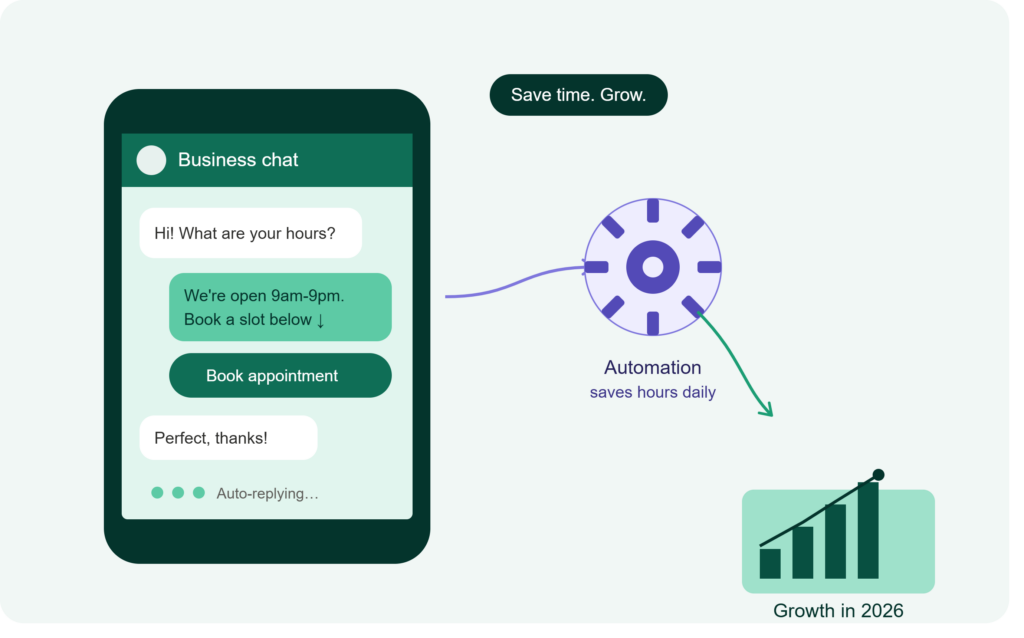
For example, when a customer sends a message, an automated system can:
- Send an instant greeting
- Answer frequently asked questions
- Share product or service information
- Collect customer details
- Qualify leads
- Send appointment or booking confirmations
- Follow up with potential customers
- Send payment or order updates
- Transfer complex conversations to a human agent
This allows businesses to provide faster communication while reducing repetitive manual work.
Why Is WhatsApp Automation Important for Businesses?
Traditional customer communication often involves manually replying to every enquiry. As the number of customers increases, this can become difficult to manage. WhatsApp Automation for Businesses allows companies to respond faster and manage a growing number of customer enquiries.
WhatsApp Automation for Businesses can be used across industries including real estate, e-commerce, education, healthcare, and professional services. Automated workflows can help businesses manage enquiries, bookings, reminders, customer support, and follow-ups.
WhatsApp automation helps businesses create a more organized communication process.
1. Instant Customer Responses
Customers don’t always contact businesses during working hours. An automated WhatsApp system can provide immediate responses to common questions, even when the team is unavailable.
For example:
Customer: What are your services?
Automated Response: Hi! Thanks for contacting us. Please select an option below:
- Website Development
- WhatsApp Automation
- CRM Automation
- AI Chatbot
- Digital Marketing
This gives customers an immediate starting point instead of making them wait for a response.
2. Faster Lead Follow-Ups
Following up with leads is one of the most important parts of sales.
However, businesses often lose potential customers because follow-ups are delayed or forgotten.
WhatsApp automation can trigger follow-up messages based on customer actions.
For example:
Day 1: Thank you for your enquiry.
Day 2: Just checking if you had a chance to review our services.
Day 4: Would you like to schedule a quick call with our team?
Automated follow-ups help businesses maintain consistent communication without requiring employees to remember every follow-up manually.
3. Better Lead Qualification
Not every lead has the same requirements.
WhatsApp automation can ask customers a series of questions before sending the conversation to the sales team.
For example:
- What service are you interested in?
- What is your estimated budget?
- When do you want to get started?
- What is your business type?
- How can we help you?
The collected information can then be passed to the sales team.
This means sales representatives can spend more time talking to qualified prospects rather than collecting basic information.
4. Improved Customer Support
Many customer support questions are repetitive.
Customers may frequently ask:
- What are your prices?
- What are your working hours?
- Where are you located?
- How can I book a service?
- What payment methods do you accept?
- How long does the process take?
Businesses can automate responses to these frequently asked questions.
For more complex issues, the chatbot can transfer the conversation to a human representative.
This creates a balance between automation and personal support.
5. Automated Notifications and Updates
WhatsApp automation can also be used to send important updates to customers.
Businesses can automate notifications such as:
- Appointment reminders
- Order confirmations
- Booking confirmations
- Payment reminders
- Delivery updates
- Service updates
- Feedback requests
These automated notifications keep customers informed and reduce the need for manual communication.
6. Integration With CRM Systems
One of the biggest advantages of WhatsApp automation is its ability to work alongside CRM systems.
When a customer contacts a business, their information can be captured and organized in a CRM.
For example:
WhatsApp Enquiry → Lead Capture → CRM → Lead Qualification → Sales Follow-Up → Conversion
This creates a smoother customer journey and gives businesses better visibility into their leads.
CRM integration can also help teams track conversations, assign leads, monitor follow-ups, and manage customer information from one place.
7. AI Chatbots and WhatsApp Automation
Artificial intelligence is making business automation even more powerful.
AI chatbots can understand customer questions and provide more natural responses compared with basic rule-based chatbots.
For example, instead of responding only to a specific keyword such as “pricing,” an AI chatbot can understand questions like:
“How much does your website development service cost?”
and guide the customer toward the appropriate information.
AI-powered automation can be particularly useful for businesses that receive a large number of customer enquiries.
WhatsApp Automation vs. Manual Customer Communication
| Manual Communication | WhatsApp Automation |
|---|---|
| Requires constant human involvement | Handles repetitive tasks automatically |
| Follow-ups can be forgotten | Automated follow-up workflows |
| Slower response times | Instant responses |
| Difficult to manage high enquiry volumes | Can handle multiple conversations |
| Customer information may be scattered | Can integrate with CRM systems |
| Limited outside working hours | Can provide 24/7 automated responses |
Automation doesn’t necessarily mean replacing human employees.
Instead, it allows employees to focus on conversations that actually require human attention.
How Different Businesses Can Use WhatsApp Automation https://developers.facebook.com/docs/whatsapp/?utm_source=chatgpt.com
WhatsApp automation can be useful across many industries.
E-commerce
Online stores can use automation for:
- Order confirmations
- Shipping updates
- Product enquiries
- Abandoned-cart follow-ups
- Customer support
Real Estate
Real estate companies can automate:
- Property enquiries
- Lead qualification
- Property recommendations
- Site-visit scheduling
- Follow-ups
Education and Coaching
Educational businesses can use WhatsApp automation for:
- Course enquiries
- Admission information
- Demo class bookings
- Fee reminders
- Student communication
Healthcare and Clinics
Clinics can use automation for:
- Appointment bookings
- Appointment reminders
- Basic FAQs
- Follow-up messages
- Patient communication
Service-Based Businesses
Agencies, consultants, and other service providers can use WhatsApp automation to capture enquiries, qualify prospects, schedule calls, and manage follow-ups.
How to Get Started With WhatsApp Automation https://www.cloudfoldstudio.com/digital-transformation-services/?utm_source=chatgpt.com
Implementing WhatsApp automation doesn’t have to be complicated.
Step 1: Identify Repetitive Tasks
Start by identifying the questions and tasks your team handles repeatedly.
Step 2: Create Your Conversation Flow
Decide how customers should move through the conversation.
For example:
Greeting → Service Selection → Requirement Collection → Lead Qualification → Sales Team
Step 3: Automate Common Responses
Create helpful responses for frequently asked questions and common customer requests.
Step 4: Connect Your CRM
Integrate WhatsApp with your CRM so that customer information and leads can be organized automatically.
Step 5: Add Human Handover
Automation should not handle everything.
Give customers an option to connect with a real person when they have a complex question or need personalized assistance.
Step 6: Track and Improve
Monitor important metrics such as:
- Response rate
- Lead conversion rate
- Follow-up performance
- Customer engagement
- Number of qualified leads
Use these insights to improve your automation workflows over time.
Common Mistakes to Avoid With WhatsApp Automation
While automation can be powerful, poor implementation can negatively affect customer experience.
Using Too Many Automated Messages
Customers don’t want to feel like they are talking to a machine at every step.
Keep automated conversations simple and useful.
Making It Difficult to Reach a Human
Always provide a clear option to speak with a human representative when necessary.
Sending Irrelevant Messages
Automation should be based on customer needs and actions. Avoid sending unnecessary or excessive messages.
Ignoring Data and Privacy
Businesses should use appropriate consent, privacy practices, and compliant messaging processes when communicating with customers.
The Future of WhatsApp Automation
WhatsApp Automation for Businesses can help businesses save time while maintaining consistent customer communication.
Business communication is becoming increasingly automated and AI-powered.
In 2026, businesses can combine WhatsApp automation, CRM automation, AI chatbots, email automation, and digital marketing to create connected customer journeys.
WhatsApp Automation for Businesses can help sales teams qualify leads and automate timely follow-ups.
Instead of treating each communication channel separately, businesses can build an automated system where leads move smoothly from enquiry to qualification, follow-up, and conversion.
The businesses that implement automation strategically can spend less time on repetitive tasks while creating a faster and more consistent customer experience.
How Cloud Fold Studio Can Help
At Cloud Fold Studio, we help businesses use automation and digital solutions to improve their customer communication and growth processes.
Our services include:
- WhatsApp Automation
- CRM Automation
- AI Chatbots
- Email Automation
- UGC Automation
- Website Development
- Meta Ads Setup
- Google Ads Setup
From capturing a lead through WhatsApp to managing it through a CRM and following up automatically, we can help you build a more connected workflow.
Different industries can use WhatsApp Automation for Businesses to manage enquiries, bookings, reminders, and customer support.
Ready to automate your customer communication?
Get in touch with Cloud Fold Studio and discover how WhatsApp automation can help your business save time, manage leads, and improve customer engagement.
Frequently Asked Questions
What is WhatsApp automation for businesses?
WhatsApp automation allows businesses to automatically handle repetitive customer communication, including instant replies, FAQs, lead collection, follow-ups, notifications, and customer support.
Is WhatsApp automation suitable for small businesses?
Yes. Small businesses can use automation to save time, respond faster to enquiries, and maintain consistent follow-ups without requiring a large customer-support team.
Can WhatsApp automation generate leads?
Yes. Automated WhatsApp workflows can collect customer information, ask qualifying questions, and send qualified leads to a sales team or CRM.
Can WhatsApp automation be connected to a CRM?
Yes. WhatsApp automation can be integrated with CRM systems to capture and organize customer information, track leads, and automate follow-ups.
Can AI chatbots work with WhatsApp automation?
Yes. AI chatbots can be combined with WhatsApp automation to understand customer questions, provide relevant responses, collect information, and transfer conversations to human agents when required.
Is WhatsApp automation better than manual customer support?
Automation and human support work best together. Automation can handle repetitive tasks and common questions, while human representatives can handle complex or personalized conversations.
Conclusion
WhatsApp Automation for Businesses is becoming an important solution for companies that want to improve customer communication, manage leads, and reduce repetitive work. From instant responses and automated follow-ups to CRM integration and customer support, businesses can create a more efficient communication process.
For growing companies, WhatsApp Automation for Businesses can become an important part of an efficient digital communication strategy
The goal isn’t to replace human interaction. Instead, automation handles repetitive tasks while your team focuses on conversations that require personal attention.
Cloud Fold Studio helps businesses build smarter automation workflows using WhatsApp, CRM, email, AI chatbots, and other digital solutions.
Ready to automate your customer communication? Contact Cloud Fold Studio today and build a smarter workflow for your business.


 Aug 03, 2026