



10 First-Time Founder Mistakes (And How to Avoid Them)

 Aug 01,2026
  By Muhammad Danish
 Table of Contents
Starting a company for the first time feels like learning to drive and navigate a new city at the same time. You’re managing product, cash, hiring, and customers, often before you’ve had a chance to make a single mistake and learn from it. That’s exactly why first-time founder mistakes tend to repeat themselves across industries, decades, and geographies.
The numbers back this up. First-time founders succeed at roughly an 18% rate, compared to 30% for repeat entrepreneurs who’ve already made (and survived) their first round of mistakes. That gap isn’t about talent. It’s about pattern recognition, and pattern recognition is something you can borrow before you have to earn it the hard way.
At Cloud Fold Studio, we work alongside early-stage teams building and scaling SaaS products, and we see the same first-time founder mistakes show up again and again. Below are the ten that cost founders the most time, money, and morale, along with what to do instead.
1. Building Before Validating Demand
The single biggest driver of startup failure isn’t a bad product. It’s a product nobody needed in the first place. According to CB Insights’ analysis of startup post-mortems, lack of market need accounts for roughly 42% of startup shutdowns, more than any other cause. This is the most expensive of all first-time founder mistakes because it can take months or years to surface.
Founders fall in love with a solution before confirming the problem is real, widespread, and painful enough that people will pay to fix it. Avoid this by:
- Talking to at least 20-30 potential customers before writing a line of code
- Asking about their current workaround, not just whether they’d “use” your idea
- Charging something, even a small deposit, to test real willingness to pay
2. Running Out of Cash Before Running Out of Ideas
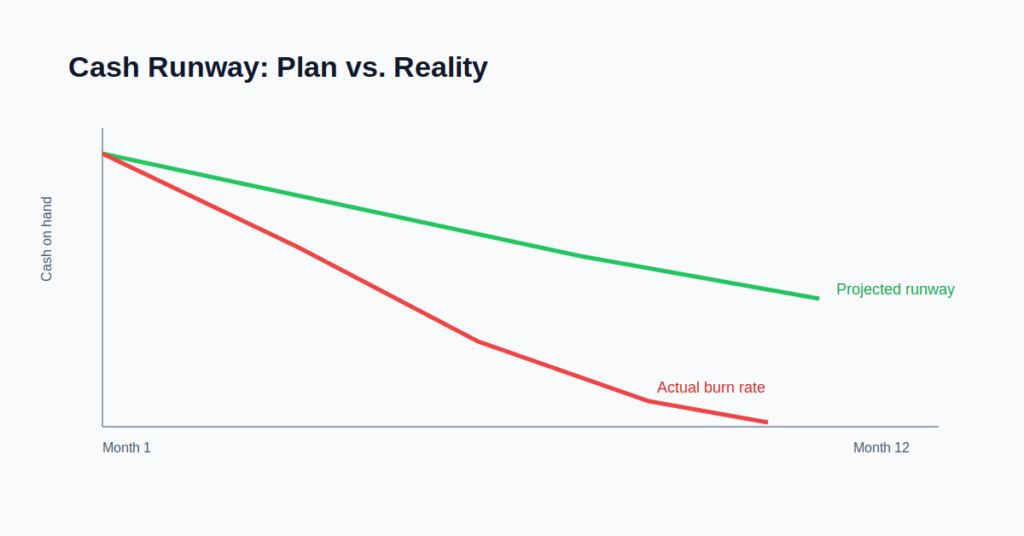
Cash problems are the second-biggest cause of startup failure, contributing to roughly 29% of shutdowns. Combined with weak product-market fit, these two issues explain the majority of failures founders face. Running out of runway rarely happens overnight, which is part of why treating cost visibility as a habit rather than a quarterly scramble tends to catch cash problems while they’re still fixable.
First-time founders often underestimate how long it takes to reach meaningful revenue, and overestimate how quickly investors will say yes. A tighter budget and a longer runway will always beat an aggressive burn rate and a shorter one.
3. Hiring Too Fast, Too Early
Team-related issues, including bad hires, missing skills, and founder conflict, are consistently cited among the top reasons startups stall out. It’s tempting to hire quickly once funding lands, but every early hire shapes your culture, burn rate, and decision-making speed long after they join.
Founders often equate headcount with progress, which is one of the more expensive first-time founder mistakes to unwind. Reversing a bad hire costs months of momentum, and the tools and subscriptions a growing team accumulates can quietly turn into the same kind of sprawl that slows teams down long after the hiring decision itself.
This is one of the first-time founder mistakes that feels productive in the moment. Headcount looks like progress. But a team of the wrong people moving fast is often slower than a small team of the right people moving deliberately.
4. Skipping Co-Founder Alignment
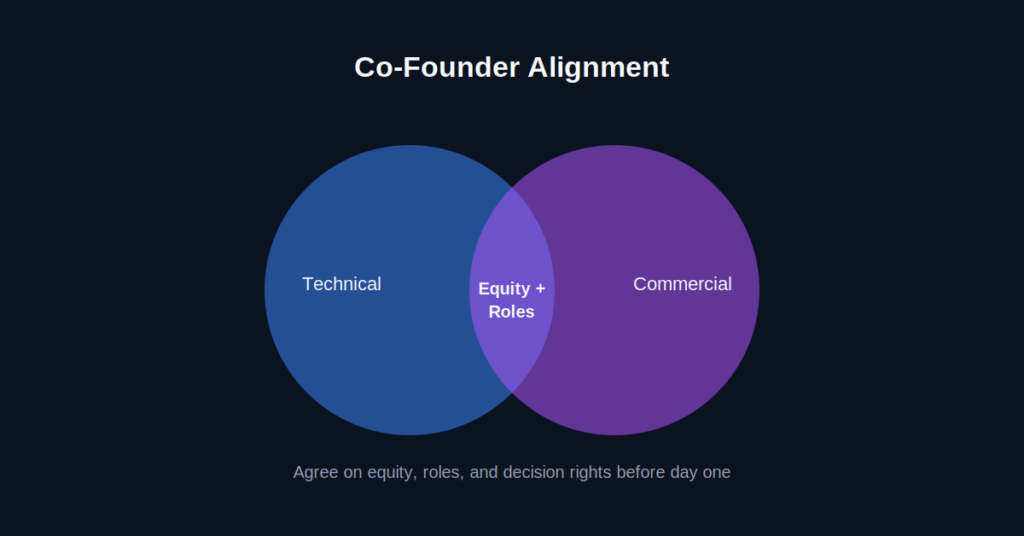
Startups with two co-founders tend to raise more funding than solo founders, but co-founder conflict is also one of the most common causes of early startup failure. The optimal co-founder relationship pairs complementary skills, typically technical and commercial, with clear agreement on equity, roles, and decision rights before any code gets written.
Skipping that conversation because it feels awkward or premature is a mistake that tends to resurface at the worst possible moment, usually right when the company needs its founders most aligned.
5. Ignoring Go-to-Market Until the Product Is “Ready”
Founders with technical backgrounds especially tend to treat marketing as a problem for later. But weak marketing execution is a leading cause of startup failure, and treating distribution as an afterthought is one of the classic first-time founder mistakes. Waiting until launch day to think about distribution means you’re starting your growth curve from zero on the day you need it most.
Go-to-market planning should start the same week you start building. Who is your first customer? Where do they already spend time? What will make them notice you before a competitor does?
6. Chasing Every Opportunity Instead of One Market
Trying to serve everyone is one of the more common first-time founder mistakes, and it usually comes from fear of leaving money on the table. In practice, it spreads a small team’s resources so thin that no single segment gets served well enough to generate real traction.
A narrow, well-served niche builds momentum faster than a broad, half-served market. You can always expand later. It’s much harder to walk back a scattered brand and an unfocused product roadmap.
7. Scaling Before Unit Economics Work
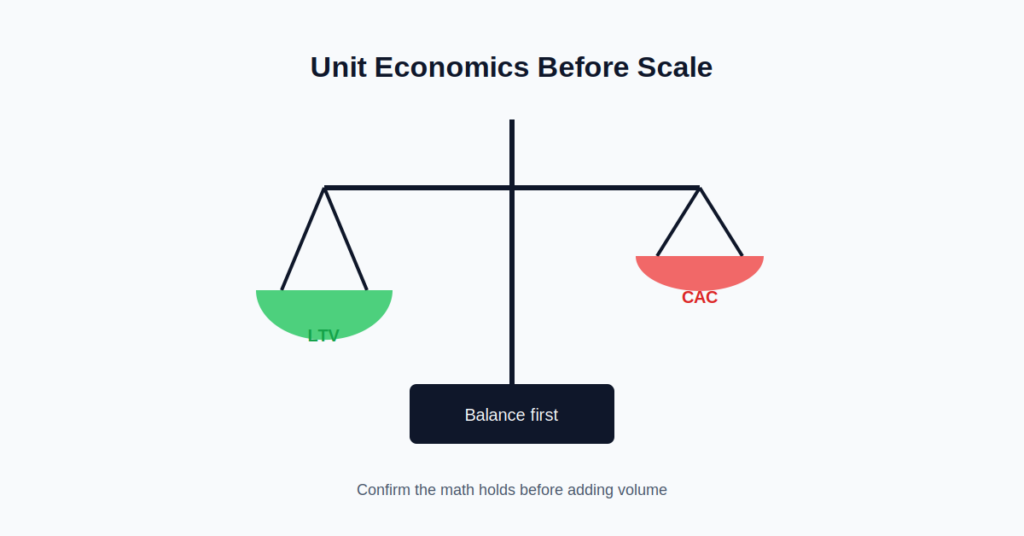
Overexpansion, scaling headcount, spend, or geography before the underlying economics are proven, is a recurring cause of startup collapse. It’s a natural instinct to want to move fast once something starts working, but growth amplifies whatever is already true about your business, good or bad.
Before scaling, confirm the math holds at a small scale first. If customer acquisition costs exceed lifetime value on a handful of customers, that problem only gets worse with a thousand more. Getting your pricing model aligned with the value customers actually get early on makes this math far easier to trust before you scale it up.
8. Avoiding Mentorship and Outside Perspective
Startups with mentors are reportedly three times more likely to succeed than those without one. Yet many first-time founders avoid seeking guidance, either from pride, isolation, or simply not knowing where to look. This is one of the more fixable first-time founder mistakes on this list, and one of the highest-leverage to correct.
A good mentor won’t hand you answers, but they will help you ask better questions faster than trial and error alone. If you don’t have one yet, that’s worth prioritizing this quarter, not someday.
9. Confusing Founder Burnout for Normal Stress
Founder burnout contributes to a meaningful share of startup failures, and it’s rarely treated as a real risk until it’s already done damage. The always-on culture of early-stage founding can quietly erode decision-making quality long before it shows up as an obvious crisis.
Protecting your own capacity isn’t indulgent, it’s operationally necessary. A burned-out founder makes worse decisions at exactly the moments those decisions matter most, which is why burnout deserves a place on any honest list of first-time founder mistakes rather than being dismissed as an inevitable cost of doing business.
10. Waiting Too Long to Course-Correct
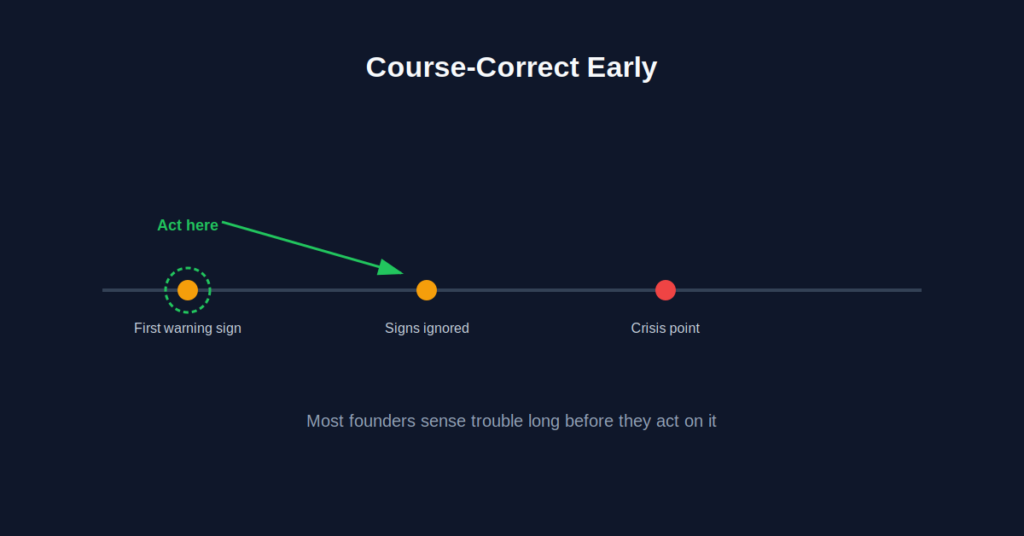
Perhaps the most common thread across failed startups is founders who sensed something was wrong long before they acted on it. Most shutdowns trace back to warning signs that were visible months in advance, not sudden surprises.
Of all the first-time founder mistakes on this list, this one is the quiet multiplier of the other nine. Fast, honest self-assessment, even when it’s uncomfortable, is consistently what separates founders who recover from a wrong turn and founders who don’t.
How to Avoid First-Time Founder Mistakes Going Forward
None of these first-time founder mistakes are unique to any one industry, and none of them require inexperience to fix. What separates founders who improve from founders who repeat the same mistakes twice usually comes down to a few habits:
- Validate demand before you validate your own assumptions
- Keep runway longer than feels comfortable
- Hire slowly and deliberately, especially in the first year
- Put a mentor or advisor in your corner early, not after something breaks
- Review your numbers and warning signs on a set schedule, not just when something feels off
First-time founder mistakes are almost never about a lack of intelligence or effort. They’re about missing the pattern recognition that only comes from having made the mistake once already, or having someone in your corner who has.
At Cloud Fold Studio, we work with early-stage teams building the systems, tools, and processes that help startups avoid the most common and costly missteps. If you’re building something new and want a second set of eyes on where the risk actually sits, reach out for a free assessment of where your current setup might be quietly working against you.


 Aug 18, 2026