


Will AI Replace SaaS Workflows by 2027? What the Data Says

 Jul 04,2026
  By Muhammad Danish
 Table of Contents
Will AI Replace SaaS Workflows by 2027? Shocking Data
A quiet software correction. A $285 billion stock drop in a single day. A new phrase — “SaaSpocalypse” — that didn’t exist eighteen months ago.
What “AI Replace SaaS Workflows” Actually MeansThe Data Behind the AI-Replace-SaaS-Workflows DebateWhere AI Is Already Replacing SaaS WorkflowsWhere Traditional SaaS Still WinsWill AI Replace SaaS Workflows by 2027? What the Predictions SayHow This Plays Out for a Typical BusinessHow to Prepare Without Overreacting
Will AI replace SaaS workflows by 2027? It’s no longer a hypothetical question. In February 2026, software stocks lost roughly $285 billion in market value in a single trading session, with Salesforce, ServiceNow, and Intuit all falling sharply the same day. That wasn’t a recession. It was investors pricing in the idea that AI could replace SaaS workflows fast enough to break the per-seat subscription model that funded the industry for two decades.
At Cloud Fold Studio, we hear this question from two directions. Some businesses want to know if AI will replace their entire SaaS stack. Others assume “AI replacing SaaS workflows” is mostly hype. The honest answer sits in the middle, and the data backs that up.
What “AI Replace SaaS Workflows” Actually Means
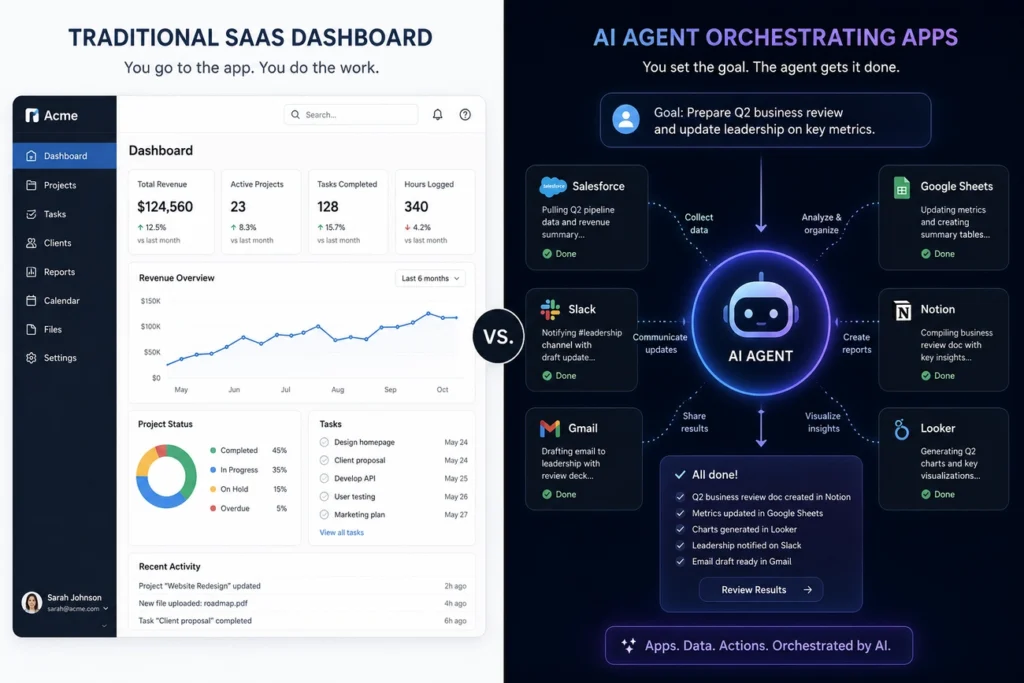
Nobody serious is claiming AI will delete Salesforce or Workday overnight. What’s actually happening when people say AI replace SaaS workflows is narrower and more specific: AI agents are taking over the repetitive, rule-based tasks that used to require a dedicated tool and a dedicated subscription.
Instead of buying five separate apps for project tracking, email marketing, support tickets, reporting, and data entry, companies are increasingly building one AI agent that handles the outcome across all of them. The shift getting described as “AI replacing SaaS workflows” is really a move from one tool per task to one agent per outcome.
That distinction matters. It’s not SaaS disappearing — it’s SaaS being unbundled, one workflow at a time.
The Data Behind the AI-Replace-SaaS-Workflows Debate
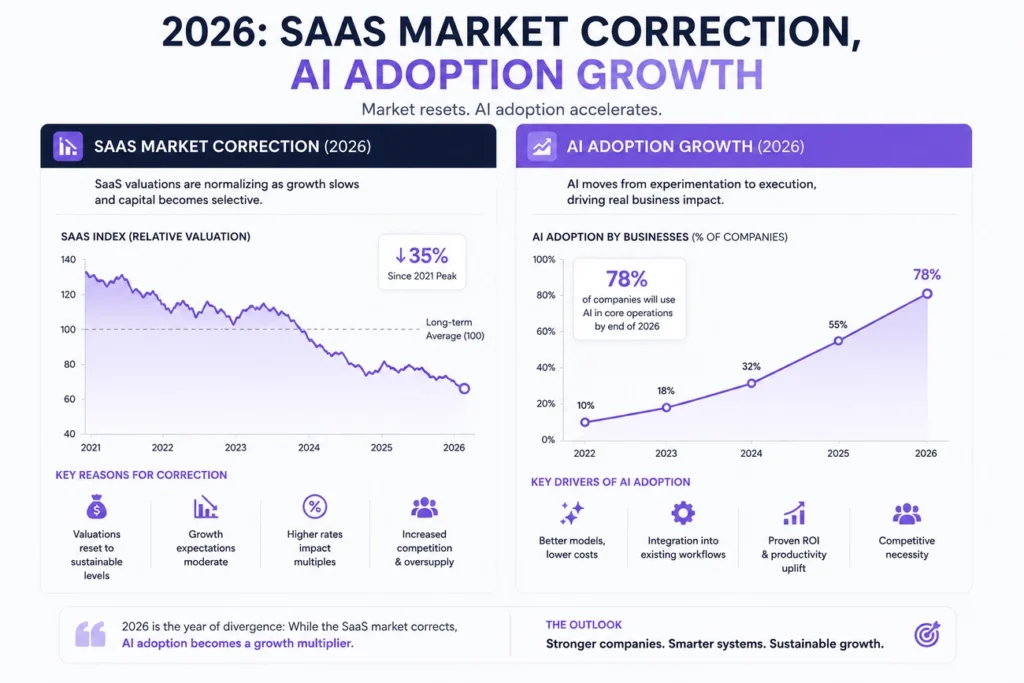
The numbers are worth sitting with. Roughly 95% of organizations now use some form of AI-powered SaaS tool, and research suggests up to 35% of point-product SaaS tools could be replaced by AI agents by 2030. Some consulting firms have already cut traditional software licenses by close to half, swapping standalone platforms for generative AI tools.
Consolidation, more than outright replacement, is the clearer 2026 trend. Analysts project that half of large enterprises will run on fewer than 150 applications by 2027, down from 300 or more today, largely because platform-native AI features can now absorb tasks that used to require separate point solutions.
Pricing is shifting for the same reason. Once a single AI-equipped employee can outproduce ten unaided ones, per-seat licensing stops making sense — the software vendor captures none of that extra productivity under the old model. That’s the real mechanism behind the idea that AI replace SaaS workflows: it’s a pricing problem as much as a capability one.
Where AI Is Already Replacing SaaS Workflows
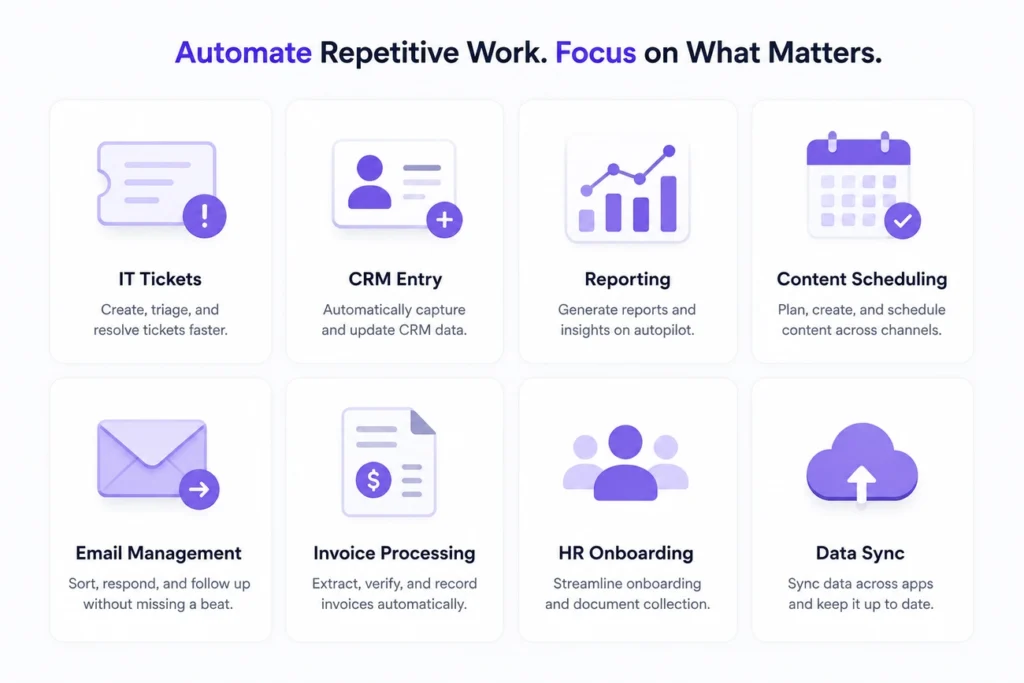
Not every SaaS category faces the same pressure. The workflows most exposed to AI replacing SaaS right now tend to be repetitive and rule-based rather than data-heavy or relationship-driven:
- Tier-1 IT support tickets, handled end-to-end by autonomous agents
- Basic CRM data entry, lead enrichment, and follow-up sequencing
- Monthly reporting and invoice processing
- Content scheduling and queue management
- Research and competitive intelligence tasks that used to take an analyst 45 minutes
Industry researchers estimate autonomous systems could handle 60–80% of these kinds of routine enterprise workflows by 2027 — which is the clearest evidence yet that AI replace SaaS workflows in this specific category well before it touches core systems of record.
Where Traditional SaaS Still Wins
This is the part that gets left out of the more dramatic headlines about AI replacing SaaS. Platforms with strong network effects, large proprietary data sets, and deep regulatory compliance built in — think Salesforce, Workday, SAP — face far less near-term displacement than simple task-execution tools.
The reasoning is straightforward: AI agents need a system of record to act on. CRMs and ERPs are becoming infrastructure that agents orchestrate on top of, not the thing AI replaces. Commercial SaaS platforms hold the cross-functional data that makes AI genuinely useful at scale, and that advantage doesn’t vanish just because agents get smarter.
So the more accurate prediction isn’t that AI will replace SaaS workflows entirely. It’s that commoditized point solutions get absorbed while data-rich platforms evolve into agent-orchestration layers instead of being replaced outright — proof that “AI replace SaaS workflows” is a spectrum, not a switch.
Will AI Replace SaaS Workflows by 2027? What the Predictions Say
Strip away the framing and most serious forecasts land in a similar place. Major research firms expect a meaningful minority of point-product SaaS — often cited around a third — to be displaced by AI agents in the next few years, not the majority. Meanwhile, spending on AI-enabled applications is projected to grow more than 40% year-over-year through 2026, showing AI is layering onto software budgets as much as replacing them.
The more consistent theme across analysts asking whether AI replace SaaS workflows by 2027 is timing pressure rather than extinction: 2027 shows up repeatedly as the point where autonomous agents handle the bulk of routine workflow execution, while judgment-heavy, relationship-based, and compliance-critical software keeps its seat at the table.
How This Plays Out for a Typical Business
A pattern we see often: a mid-sized company runs eight or nine SaaS subscriptions covering scheduling, support, email, and reporting. Nothing’s broken exactly — it’s just fragmented, and someone spends hours a week stitching outputs together manually.
Over a few quarters, that business consolidates three or four of those tools into a single AI agent that handles the workflow end-to-end, while keeping its core CRM and accounting platform in place as the system of record. The result isn’t “AI replaced all our SaaS.” It’s fewer subscriptions, less manual coordination, and a smaller, smarter stack.
That’s a far more common outcome than a business ripping out its entire stack overnight — a useful reference point if you’re mapping out your own automation roadmap rather than reacting to headlines about AI replacing SaaS workflows.
How to Prepare Without Overreacting
If you’re weighing whether AI will replace SaaS workflows in your own business, a few practical steps beat a wholesale rebuild:
Audit your stack by function, not by app. Ask whether each tool executes a repeatable workflow or stores irreplaceable relational data — the first category is where the pressure of AI replacing SaaS workflows is highest.
Pilot one agent on one workflow this quarter. IT ticketing, lead qualification, and monthly reporting tend to show the fastest measurable time savings.
Don’t cancel contracts before the agent is proven. Run the AI workflow in parallel with the existing tool for 60–90 days before deciding AI has actually replaced that SaaS workflow for good.
Revisit vendor pricing conversations. If a platform still charges strictly per seat while promoting AI features, ask how that aligns with the productivity gains it’s advertising.
Whether AI fully replaces SaaS workflows by 2027 or simply reshapes which ones survive, the businesses ahead are the ones auditing their stack now — not waiting for the next headline to force the decision.
Not sure where your stack stands on AI replacing SaaS workflows? At Cloud Fold Studio, we help you figure out which tools are worth keeping, which workflows are ready for an AI agent, and how to make that switch without disrupting what’s already working. Reach out for a free assessment.
Sources: Deloitte, “SaaS Meets AI Agents”; CIO, “Is AI the End of SaaS as We Know It?”; Orbilon Technologies, “AI Agents Replacing SaaS Tools: What It Means for 2026”; Modall, “SaaS Trends 2026”; Intellectia, “Will AI Disrupt SaaS Business Model?””


 Aug 18, 2026