



Data Privacy Checklist: 7 Points for Cloud Tools

 Jul 08,2026
  By Muhammad Danish
 Table of Contents
One “AccepOne “Accept” click can undo years of careful compliance work.
Why Every New Cloud Tool Needs a ChecklistThe Direct Risk of Skipping ItHow Privacy Gaps Compound Over TimeThe Data Privacy Checklist, Item by ItemThe Compliance Cost of Moving Too FastThe Human Cost: Trust and LiabilityCustomer Expectations Won’t Wait EitherA Familiar Pattern: How This Plays OutHow to Build the Habit the Smart Way
Adopting a new cloud tool is usually treated as a procurement decision. Someone finds a platform that solves a problem and rolls it out to the team. Rarely does anyone ask where the data goes or what happens if the vendor gets breached. Skipping a data privacy checklist at this stage feels harmless. It rarely stays that way.

At Cloud Fold Studio, we’ve watched this pattern play out across dozens of businesses. The teams that skip this step almost always pay for it later, through a compliance scramble, broken client trust, or a breach notification nobody wanted to send. This article covers why the habit matters, what belongs on the list, and how to build it before your next tool signup.
Why Every New Cloud Tool Needs a Checklist
Every cloud tool your business connects to becomes an extension of your own data environment. Customer records and financial information can end up on servers you don’t control, governed by terms of service most people never read.
A data privacy checklist exists to catch what a demo call won’t. It forces one simple question before any contract gets signed: if this vendor mishandles our data, are we still compliant, and still safe?
Without a data privacy checklist, the default is trust by convenience. The tool looks polished and the team is under pressure to ship. None of that tells you where the data is stored, or whether the vendor can legally hand it to a third party.
The Direct Risk of Skipping It
The risk rarely shows up on day one. It surfaces months later, when a client asks where their data lives, or an audit request reveals a vendor nobody vetted.
Unvetted tools cluster around the same weak points: data stored in regions your contracts don’t allow, unclear retention rules, or subprocessors buried in a privacy policy nobody read. A data privacy checklist surfaces these issues while there’s still time to choose a different vendor.
It’s not only about breaches. Many regulators penalize inadequate vendor oversight even when no data ever leaked. The paperwork trail matters as much as the outcome.
How Privacy Gaps Compound Over Time
Privacy debt behaves like technical debt. Every tool adopted without review adds one more unknown to a growing pile. Individually, each skipped step feels minor. Together, they create a sprawling map of vendors and data flows nobody can fully explain.
That’s when audits get painful. Teams scramble to reconstruct which tools touch which data, often finding integrations that were never formally approved.
Businesses that apply a data privacy checklist from the start avoid this scramble. Every new tool gets reviewed once and added to a system that’s easy to audit later. Businesses that skip it do the same work eventually, just under far more pressure.
The Data Privacy Checklist, Item by Item
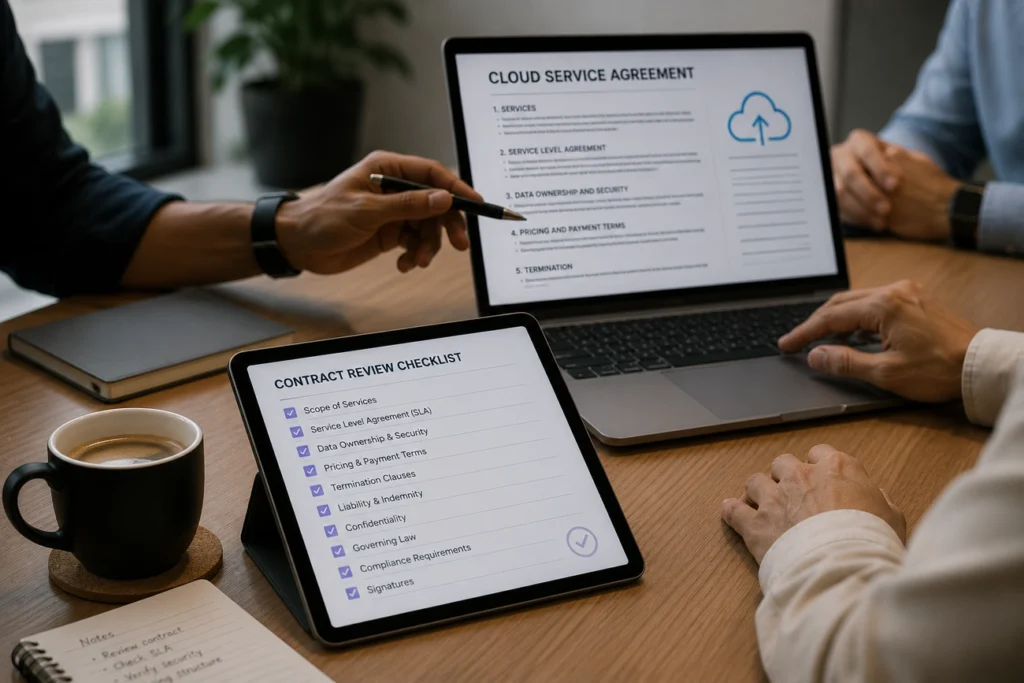
A practical checklist doesn’t need to be exhaustive to work. A few essentials cover most of the risk:
Where is data stored and processed? Confirm the physical regions align with your regulatory obligations.
Who can access it, and how? Ask about role-based access controls and whether the vendor’s own staff can view raw customer data.
Is data encrypted in transit and at rest? This should be a baseline, not a premium feature.
What’s the subprocessor list? Any vendor worth using can share which third parties touch your data, and why.
What’s the retention and deletion policy? Know how long data is kept after cancellation, and whether deletion is verifiable.
Does the vendor support your compliance obligations? GDPR, HIPAA, or industry rules should be addressed directly.
Is there a documented incident response process? Ask how and when you’d be notified if something went wrong.
Running through these questions before signing turns the checklist from a formality into a real filter, one that quietly protects the business from decisions made under time pressure.
The Compliance Cost of Moving Too Fast
Regulators increasingly expect ongoing vendor oversight, not a one-time review. A data privacy checklist applied consistently becomes evidence that due diligence happened, which matters if a vendor is later found to have mishandled data.
Skipping it raises the odds that when something goes wrong, your business shoulders the consequences alongside the vendor, even if the failure originated on their end. The exposure isn’t hypothetical, it’s contractual, sitting dormant until an audit brings it to the surface.
The Human Cost: Trust and Liability
The cost here isn’t only regulatory. It’s personal, for customers and employees alike. Customers who trust a business with their information expect that trust honored quietly, without ever having to think about it.
When that trust breaks, whether through a breach or a vendor overreaching on data use, the damage outlasts the incident itself. Customers rarely explain why they left. They just stop coming back.
Employees carry a version of this risk too. Whoever approved the tool, however informally, often ends up answering uncomfortable questions when an audit turns something up. A data privacy checklist protects that person as much as the company, replacing a judgment call with a repeatable process.
Customer Expectations Won’t Wait Either
Customers assume their data is handled responsibly, even though few will ever ask directly. That’s exactly why this matters: businesses that skip the review are usually the ones customers never hear from again after something goes wrong.
Expectations here don’t shift gradually. A single visible incident can change how customers feel about handing over their information at all. Businesses with a consistent data privacy checklist are better positioned to answer confidently when asked how their data is protected.
A Familiar Pattern: How This Plays Out

A common scenario: a growing business adopts several cloud tools over a year or two, each chosen quickly to solve an immediate problem. No one applies a data privacy checklist consistently. Some get a quick look, others get approved in a five-minute conversation.
Everything runs fine until a client’s legal team asks for a full list of subprocessors, or a new regulation requires proof of oversight. Someone has to reconstruct months of decisions that were never documented, often finding a tool that should never have been approved.
By the time leadership addresses it, the fix costs more time and friction than a checklist applied from the start ever would have. This is the pattern behind most privacy scrambles: not one bad decision, but many small ones made without a consistent process.
How to Build the Habit the Smart Way
There’s rarely a perfect moment to formalize this. It’s easy to assume the current set of tools is fine and start “next time.” Businesses that handle it well treat it as ongoing practice, not a one-time project.
A few practical starting points:
Apply the checklist to every new tool before rollout, not after adoption is already underway.
Keep a simple, living log of vendors, what data they touch, and when they were last reviewed.
Set a recurring review, even annually, so tools adopted quickly still get a second look.
Keep it short enough that people actually use it, rather than skip it under deadline pressure.
A simple test: if you couldn’t explain where a customer’s data goes after signing up for a tool, the checklist should have caught that before the signup happened.
Not sure where your current setup stands?
At Cloud Fold Studio, we help businesses build a data privacy checklist that actually gets used, review the cloud tools already connected to their systems, and tighten up vendor security practices before they become a liability. If your team could use a second look at what’s already approved, our automation and systems audit is a good place to start.
Sources: IAPP, Vendor Privacy Risk Management guidance; NIST, Cloud Computing Security Reference Architecture.


 Aug 18, 2026