


Agentic AI vs AI-Enabled Apps: 7 Critical Differences

 Jul 02,2026
  By Muhammad Danish
 Table of Contents
Agentic AI vs AI-enabled apps is one of the most confusing debates in business technology today. Leaders hear both terms tossed around in vendor pitches, and it’s easy to assume they mean the same thing. They don’t — and picking the wrong one for your business can waste budget and stall your automation goals.
In this guide, you’ll learn exactly what separates agentic AI from a plain AI-enabled app, see real examples of each, and walk away knowing which one fits your business.
What Is an AI-Enabled App?
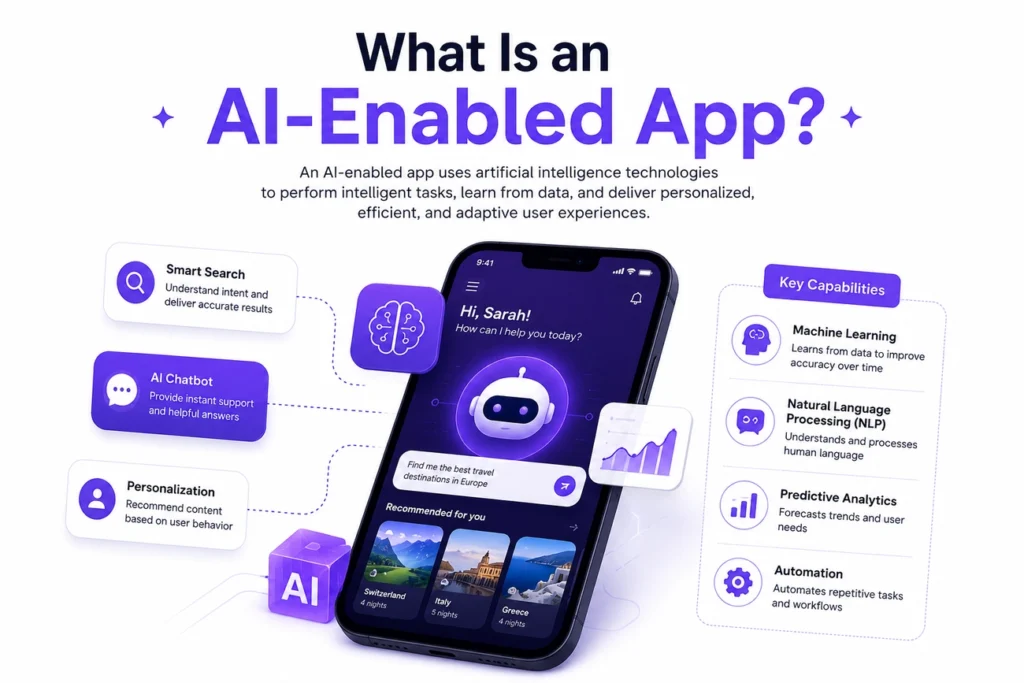
An AI-enabled app is traditional software with an AI feature bolted on. Think of a customer support tool that uses AI to suggest replies, or a spreadsheet that auto-generates a summary. The human still drives every step.
These apps are:
- Built around a fixed workflow
- Triggered by a specific user action
- Limited to single-step outputs (a suggestion, a prediction, a summary)
The AI here is a smart assistant sitting inside a larger, static product. It doesn’t plan, it doesn’t decide what to do next, and it doesn’t take action on its own.
What Is Agentic AI?
Agentic AI flips that model. Instead of waiting for instructions at every step, an agentic system can set a goal, break it into sub-tasks, use tools, and adapt its plan based on results — all with minimal human input.
For example, an agentic AI system tasked with “reduce customer churn this quarter” could:
- Pull churn data from your CRM
- Identify at-risk customer segments
- Draft and send personalized retention offers
- Track results and adjust its approach
No human had to script each of those steps. The system reasoned through the goal and acted.
Agentic AI vs AI-Enabled Apps: The Core Differences
Here’s where the agentic AI vs AI-enabled apps comparison gets practical. The table below breaks down the differences that matter most to business leaders.
| Factor | AI-Enabled App | Agentic AI |
|---|---|---|
| Autonomy | Low — human triggers each step | High — sets and pursues goals |
| Workflow | Fixed, predefined | Dynamic, self-adjusting |
| Tool use | Rarely uses external tools | Actively calls APIs, tools, other agents |
| Best fit | Well-defined, repetitive tasks | Complex, multi-step objectives |
| Oversight needed | Minimal per action | Ongoing monitoring recommended |
| Setup complexity | Lower | Higher |
The short version: an AI-enabled app answers a question. Agentic AI completes a mission.
Real-World Examples
To make the agentic AI vs AI-enabled apps distinction concrete, here are two everyday scenarios.
AI-enabled app example: A grammar checker inside your word processor flags errors and suggests fixes. You accept or reject each one.
Agentic AI example: An AI system monitors your inventory levels, forecasts demand, negotiates reorder quantities with a supplier’s ordering system, and places purchase orders automatically when stock runs low.
Anthropic’s own research on agents explores how autonomous, tool-using systems can plan and execute multi-step work, which is a helpful primer if you want the underlying technical picture.
Which One Does Your Business Actually Need?
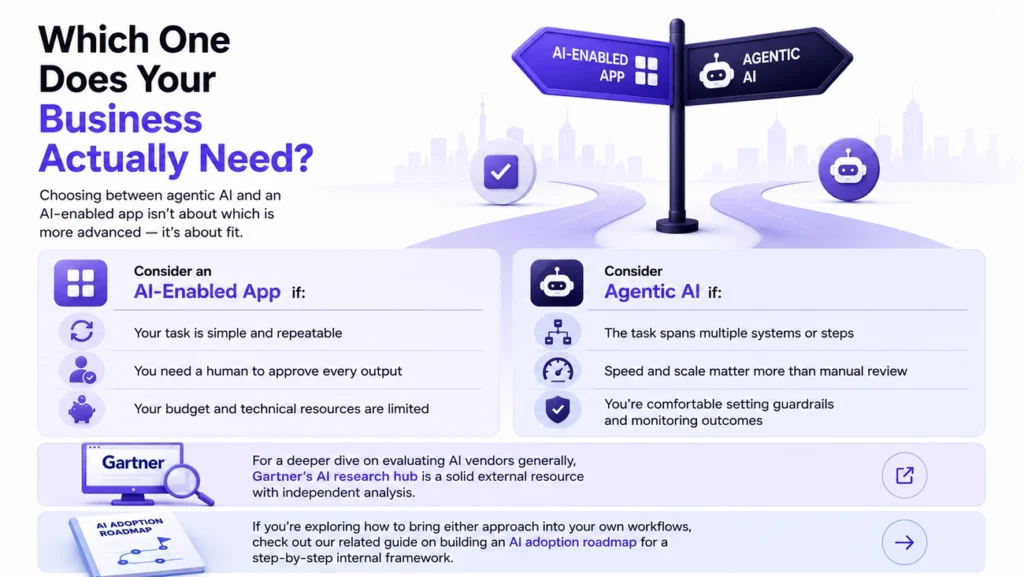
Choosing between agentic AI and an AI-enabled app isn’t about which is more advanced — it’s about fit.
Consider an AI-enabled app if:
- Your task is simple and repeatable
- You need a human to approve every output
- Your budget and technical resources are limited
Consider agentic AI if:
- The task spans multiple systems or steps
- Speed and scale matter more than manual review
- You’re comfortable setting guardrails and monitoring outcomes
For a deeper dive on evaluating AI vendors generally, Gartner’s AI research hub is a solid external resource with independent analysis.
If you’re exploring how to bring either approach into your own workflows, check out our related guide on building an AI adoption roadmap for a step-by-step internal framework.
Common Mistakes to Avoid
Even well-resourced teams stumble here. Watch out for these pitfalls:
- Overestimating autonomy. Not every “AI agent” on the market is truly agentic — many are AI-enabled apps with agentic branding.
- Skipping guardrails. Agentic systems need clear boundaries, or they can take unintended actions.
- Ignoring the maintenance cost. Agentic AI generally requires more ongoing oversight than a static AI feature.
- Choosing based on hype. The right tool depends on your task, not on which term sounds more advanced.
Final Thoughts
The agentic AI vs AI-enabled apps question isn’t about which technology wins — it’s about matching the right tool to the right job. AI-enabled apps are dependable, low-risk helpers for repetitive tasks. Agentic AI is a powerful option when you need a system that can plan, adapt, and act with minimal hand-holding.
Start by mapping your business processes, identifying where autonomy would genuinely save time, and testing on a small scale before scaling either approach across your organization.
Have questions about which approach fits your workflow? Drop them in the comments below.


 Aug 18, 2026