



Startup With No Technical Experience: 5 Proven Steps

 Aug 03,2026
  By Muhammad Danish
 Table of Contents
Not knowing how to code feels like a wall. It isn’t, and it hasn’t been for a while.
Every year, more founders launch a startup with no technical experience and reach a working product faster than plenty of technical teams. That’s not motivational fluff, it’s how software gets built in 2026. AI builders, no-code platforms, and fractional technical help have quietly moved the starting line.
This guide walks through what actually changes when you start a startup with no technical experience, where the real risk sits, and the order of operations that keeps non-technical founders from wasting the first year on the wrong problem.
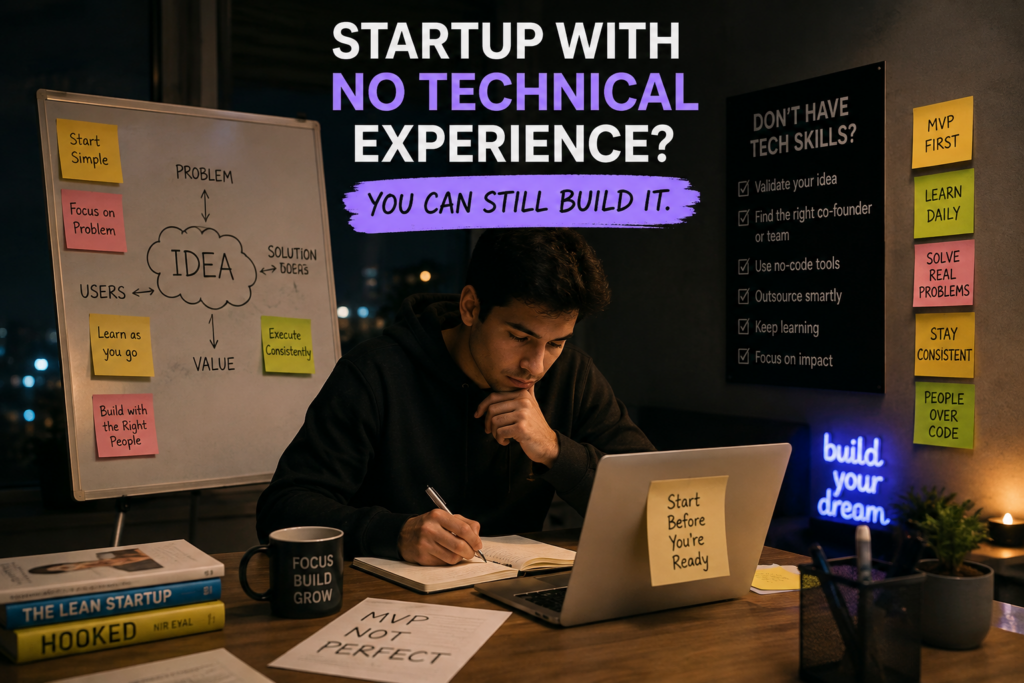
Why a Startup With No Technical Experience Isn’t a Handicap Anymore
For most of the last two decades, “non-technical founder” was code for “will eventually need a co-founder who can code.” That assumption is outdated. Gartner’s low-code market forecasts point to the low-code and no-code development market reaching roughly $44.5 billion in 2026, growing at close to 19% a year, with the majority of new business applications now built on these platforms rather than from scratch.
That shift matters more than the dollar figure. It means the tools a non-technical founder reaches for by default, drag-and-drop builders, AI app generators, automation platforms, are the same tools funded engineering teams increasingly use to move fast. Running a startup with no technical experience today means using mainstream infrastructure, not a workaround.
The gap that used to separate technical and non-technical founders was never really about who could write code. It was about who could turn an idea into something a customer could touch. That gap keeps narrowing every quarter.
Running a Startup With No Technical Experience: The Real Risk
Founders without a technical background tend to worry about the wrong risk. The failure pattern for a startup with no technical experience almost never starts with “we couldn’t build it.” It starts with building the wrong thing, for too long, before talking to a real customer.
Startup failure data backs this up. Roughly 9 in 10 startups fail within ten years, and most failures trace back to team problems, poor market fit, or running out of cash, not technical execution gaps. Coding ability was rarely the deciding factor.
Where technical inexperience does bite is communication and judgment: knowing enough to brief a contractor clearly, evaluate a quote, or tell when a no-code platform has hit its ceiling. That’s a learnable skill, not a permanent disqualifier.
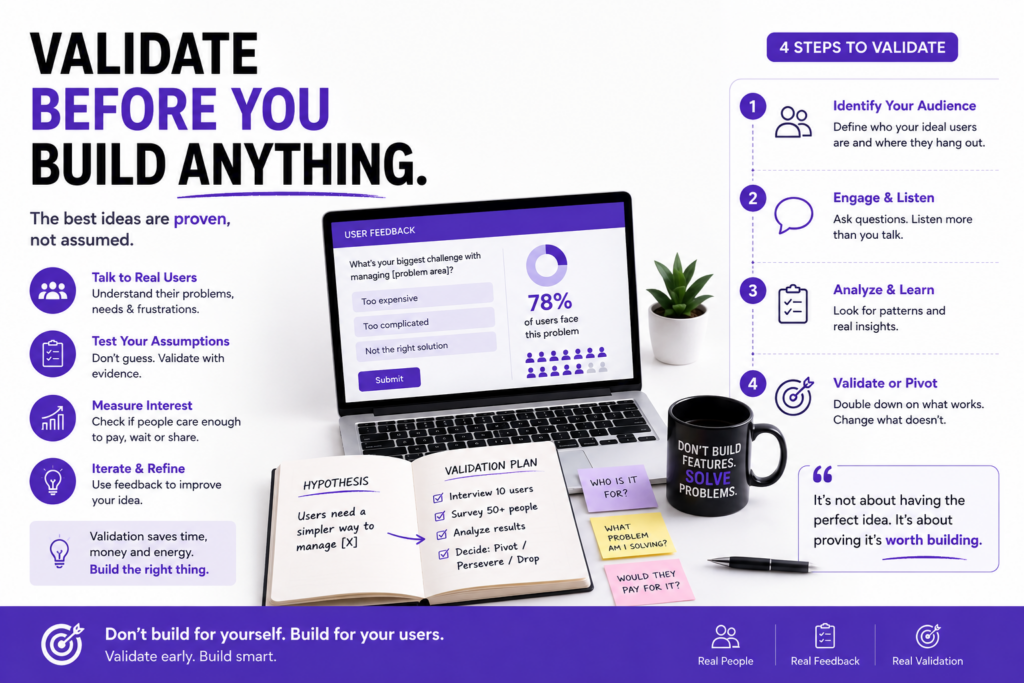
Step 1: Validate Before You Build Anything
The cheapest mistake to avoid when starting a startup with no technical experience is building a full product before anyone has confirmed they want it. A landing page, a waitlist, and a handful of real conversations will tell you more than three months of development.
Some founders go further with a concierge approach: deliver the outcome manually first, even if it’s clunky, before automating any part of it. If people will pay for the manual version, you’ve proven demand. If they won’t, you’ve saved yourself the cost of building software nobody wanted.
This step doesn’t require a single line of code. It requires a clear pitch, a way to collect interest, and the discipline to listen when the answer is “not yet.”
Step 2: How a Startup With No Technical Experience Actually Gets Built
Once there’s real demand, the next decision for a startup with no technical experience is how to actually build the thing. There are three practical paths, and they’re not mutually exclusive.
No-code and AI builder platforms let you go from an idea to a working, clickable product in days, often for a monthly fee in the low hundreds of dollars. They’re the right first move for most simple products and are genuinely good enough to launch on, not just prototype with.
Freelance or agency development makes sense once the product needs custom logic a no-code tool can’t handle. Bringing on a technical co-founder is the heavier option, usually worth it only once the idea is validated and equity is the right currency to pay with. Whichever path you pick, deciding how you’ll eventually charge for the product, including whether outcome-based pricing fits better than a flat subscription, is worth thinking about early rather than bolting on later.
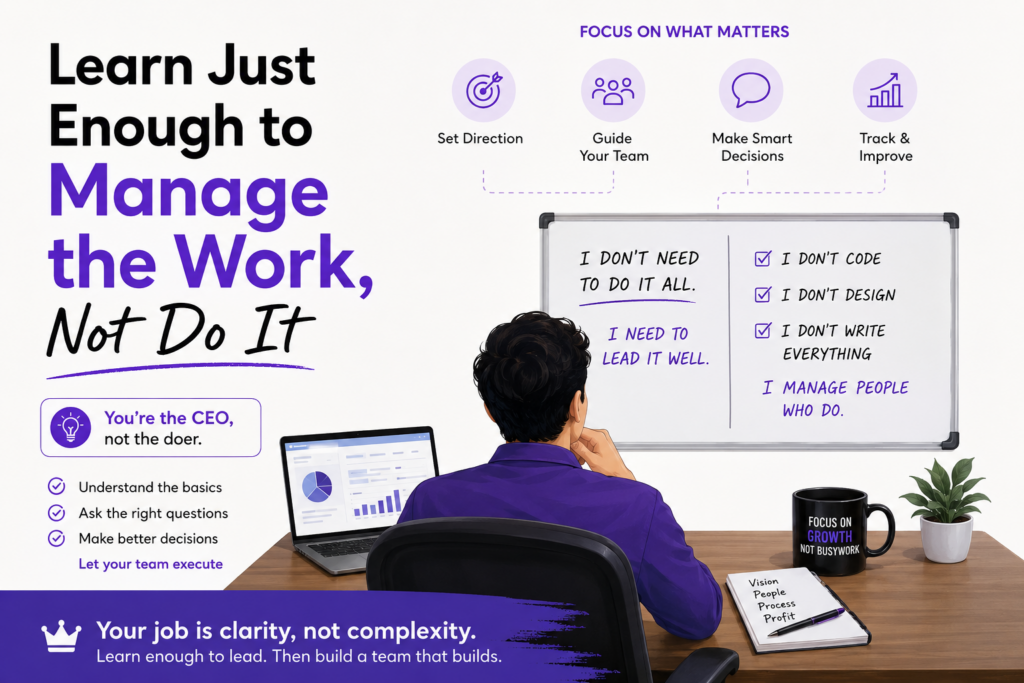
Step 3: Learn Just Enough to Manage the Work, Not Do It
You don’t need to learn to code to run a startup with no technical experience well, but you do need enough literacy to manage whoever or whatever is building it. That means understanding roughly what a database is, what an API does, and why “it’ll take two weeks” sometimes means two weeks and sometimes means two months.
A few hours with free tutorials on how the web works, how apps talk to each other, and basic project scoping will save you from getting talked into unnecessary complexity or missing red flags in a contractor’s timeline.
Treat this the way a non-technical CFO treats accounting principles: not deep expertise, just enough fluency to ask sharp questions and catch problems before they get expensive.
Step 4: Build the Business Systems Alongside the Product
It’s tempting to treat everything outside the product as secondary when you’re running a startup with no technical experience, but the systems around the product are often what determines whether it survives contact with real customers.
That includes a clean way to manage leads and outreach, a payments setup that doesn’t break at the worst moment, and clear onboarding so new users don’t churn out in the first ten minutes. This is often the stage where automating parts of the workflow with AI agents starts to make sense, once the manual version has proven itself. None of this requires custom code. It requires picking the right SaaS tools and setting them up properly instead of duct-taping five free trials together.
This is also where a lot of non-technical founders lean on outside guidance, not to write software, but to make sensible calls about which tools to combine and how to keep the stack from becoming its own maintenance problem later.
Step 5: Know When to Bring in Technical Help
There’s a point where a startup with no technical experience outgrows what no-code tools and AI builders can comfortably handle. Usage climbing fast, custom integrations, or anything touching sensitive data are common signals that it’s time for dedicated technical help.
Technical co-founders and early engineering hires typically arrive after a startup has raised meaningful early funding, which is a reasonable marker: prove the idea first, then invest in the infrastructure to scale it. Bringing in technical help too early usually means paying senior rates to build features nobody has validated yet.
When that point arrives, a fractional CTO or a specialized development partner is usually a smarter first move than a full-time hire. It gets you technical judgment without the long-term commitment before you know exactly what the product needs to become.
What Separates the Founders Who Actually Make It Work
The founders who succeed at building a startup with no technical experience aren’t the ones who eventually learn to code. They’re the ones who get relentless about the fundamentals: talking to customers early, choosing tools instead of reinventing them, and bringing in the right expertise at the right moment instead of too early or too late.
Investors have noticed the same pattern. A professional website and an active digital presence are now table stakes when evaluating early-stage companies, and most investors research a startup online before ever taking a first meeting. That’s good news for non-technical founders: the parts of the business that most influence outside perception, positioning, storytelling, and presentation, tend to be exactly where non-technical founders are strongest.
The wall never really disappears. It just moves to a different, more manageable place, one that’s far more about judgment and persistence than it is about syntax.
Getting Started Without Overbuilding
If you’re serious about launching a startup with no technical experience, the order matters more than the tools. Validate the idea in the simplest form possible, choose the lightest building method that gets you to a real product, and only add complexity, and technical hires, once the business has earned it.
At Cloud Fold Studio, we work with founders navigating exactly this stage, helping non-technical teams choose the right no-code and SaaS tools, avoid stacking software that fights itself later, and build a technical foundation that won’t need to be torn out the moment things start working. If you’re mapping out your own path, we’re happy to talk through where your idea actually stands.


 Aug 18, 2026