


Why AI-Native Applications Are Replacing Traditional Software for Online Businesses

 Jul 24,2026
  By uveskhan234
 Table of Contents
The Next Evolution of Business Software
For years, online businesses have relied on traditional software to manage operations, automate repetitive tasks, and improve productivity. From CRM platforms and project management tools to email marketing and analytics dashboards, these applications have been the backbone of digital operations.
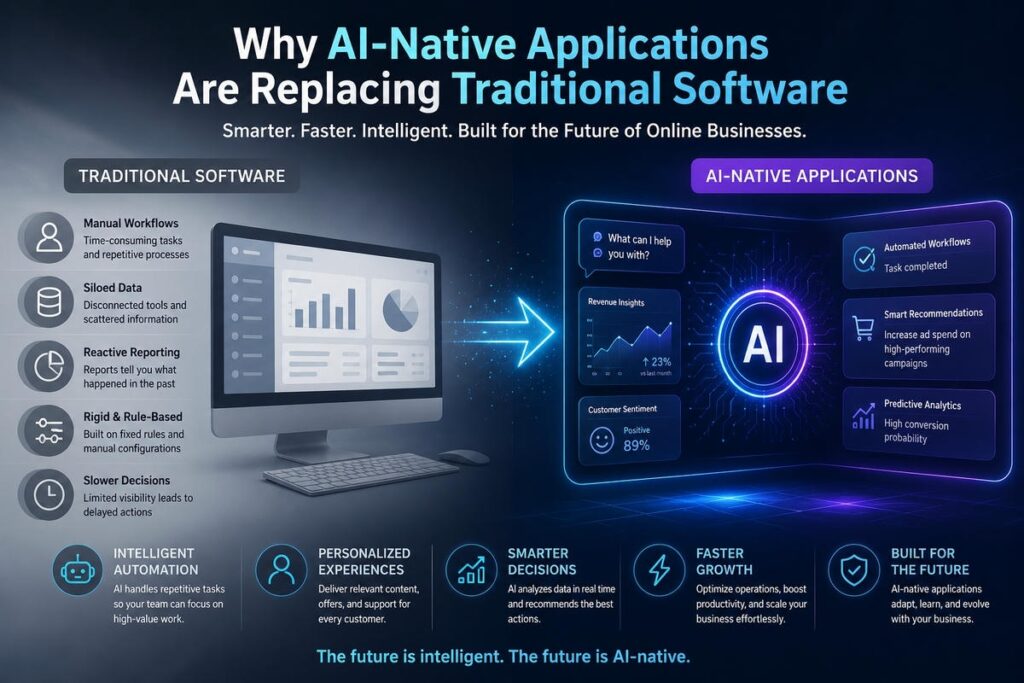
However, a new generation of software is emerging. AI-native applications are not simply traditional tools with an AI chatbot added on top. They are built around artificial intelligence from the ground up, enabling businesses to automate complex workflows, generate insights instantly, and adapt to changing customer needs in real time.
For online businesses competing in fast-moving markets, AI-native applications are becoming a competitive advantage rather than an optional upgrade.
What Are AI-Native Applications?
AI-native applications are software solutions designed with artificial intelligence as their core functionality. Instead of relying on fixed rules and manual workflows, these applications learn from data, understand user intent, and make intelligent decisions.
Unlike traditional software that requires users to navigate menus, configure settings, and manually perform actions, AI-native applications can often accomplish tasks through natural language commands.
For example:
- Instead of manually creating marketing emails, an AI-native platform generates personalized campaigns based on customer behavior.
- Rather than filtering customer support tickets manually, AI automatically categorizes, prioritizes, and drafts responses.
- Instead of building reports by selecting filters and exporting spreadsheets, users simply ask questions like, “Which products had the highest profit margin last month?”
This shift changes software from being a tool that users operate into an intelligent assistant that works alongside them.
Why Traditional Software Is Losing Its Edge
Traditional business software was designed around predefined workflows. Every action required user input, configuration, and manual decision-making.
As businesses grow, this approach creates several challenges.
Manual Processes Slow Growth
Employees spend countless hours entering data, switching between applications, updating records, and preparing reports.
AI-native applications automate these repetitive tasks, allowing teams to focus on higher-value work.
Data Overload
Online businesses generate enormous amounts of customer, marketing, sales, and operational data.
Traditional software displays this information but rarely explains what it means.
AI-native platforms analyze data continuously and surface recommendations before problems become expensive.
Customer Expectations Have Changed
Customers now expect:
- Instant responses
- Personalized experiences
- Faster support
- Relevant recommendations
Meeting these expectations with traditional software often requires multiple disconnected tools.
AI-native applications unify these capabilities into intelligent workflows.
Benefits of AI-Native Applications for Online Businesses
Smarter Customer Support
AI-powered support systems can answer common questions, summarize previous conversations, detect customer sentiment, and route complex issues to the right human agent.
This reduces response times while improving customer satisfaction.
Faster Content Creation
Marketing teams can create:
- Blog outlines
- Social media content
- Product descriptions
- Email campaigns
- Advertising copy
Instead of spending hours writing first drafts, teams can focus on editing, strategy, and creativity.
Intelligent Sales Assistance
AI-native CRM systems can identify high-value leads, predict purchasing intent, recommend follow-ups, and even draft personalized outreach emails.
Sales representatives spend less time on administrative work and more time closing deals.
Better Business Decisions
Instead of manually reviewing dashboards, business owners can ask AI questions such as:
- Which marketing campaign generated the highest ROI?
- Why did sales decrease this week?
- Which customers are likely to churn?
The AI analyzes multiple data sources and provides actionable insights in seconds.
Personalized Customer Experiences
AI-native applications analyze browsing behavior, purchase history, and customer preferences to recommend products, offers, and content tailored to individual users.
This level of personalization helps increase conversions and customer loyalty.
AI-Native Applications Are More Than Automation
Automation has existed for decades.
The difference is that AI-native applications do more than follow predefined rules.
They can:
- Understand context
- Learn from interactions
- Generate new content
- Predict outcomes
- Recommend actions
- Continuously improve performance
Instead of simply executing commands, they actively help businesses make better decisions.
Industries Seeing the Biggest Impact
Many online-first industries are already benefiting from AI-native software.
Ecommerce
Retailers use AI to optimize pricing, personalize shopping experiences, forecast demand, and automate customer support.
SaaS Companies
Software providers leverage AI for onboarding, customer success, product recommendations, and user engagement.
Digital Marketing Agencies
Agencies accelerate campaign planning, SEO research, reporting, copywriting, and performance analysis using AI-powered platforms.
Financial Services
AI helps detect fraud, automate compliance workflows, assess risk, and deliver personalized financial recommendations.
Healthcare Technology
Healthcare platforms use AI to streamline documentation, improve scheduling, and enhance patient engagement while supporting clinical decision-making.
Challenges Businesses Should Consider
Despite the benefits, adopting AI-native applications requires careful planning.
Businesses should evaluate:
- Data privacy and security
- Integration with existing systems
- AI accuracy and oversight
- Regulatory compliance
- Employee training and adoption
AI should enhance human decision-making rather than replace it entirely. Organizations that combine AI capabilities with human expertise are more likely to achieve sustainable success.
The Future of Business Software
The shift toward AI-native applications is similar to the transition from desktop software to cloud computing. Initially, businesses viewed cloud platforms as optional. Today, cloud-based software is the standard.
AI-native software is following the same path.
As these applications become more capable, businesses will spend less time operating software and more time collaborating with intelligent systems that proactively solve problems, generate ideas, and optimize workflows.
For online businesses, this means greater efficiency, faster innovation, and improved customer experiences.
Read more: https://www.cloudfoldstudio.com/ai-agents-vs-ai-chatbots/
Final Thoughts
Traditional software helped businesses digitize their operations. AI-native applications are helping businesses rethink how work gets done.
Rather than relying on static workflows and manual processes, modern organizations can leverage intelligent applications that analyze data, automate decision-making, and continuously adapt to changing business needs.
For online businesses looking to remain competitive, adopting AI-native applications is no longer just about staying current with technology. It is about building smarter operations, delivering exceptional customer experiences, and creating a foundation for long-term growth in an increasingly AI-driven digital economy.


 Aug 18, 2026