



Website vs Landing Page: 10 Proven Differences Every Business Should Know

 Jul 24,2026
  By Alisha Akhtar
 Website vs Landing Page: Which Powerful Option Converts Better?
In today’s digital world, having an online presence is no longer optional—it’s essential. However, one question many business owners ask is: Should I invest in a website or a landing page? While both serve important purposes, they are designed to achieve different goals. Understanding their differences can help you make smarter marketing decisions and maximize your lead generation efforts.
In this guide, we’ll compare websites and landing pages, explain their benefits, and help you determine which option is best for your business.
Website vs Landing Page is one of the most common questions businesses ask when building their online presence. While both are powerful digital marketing tools, they serve different purposes. A website helps establish your brand, improve SEO, and showcase your products or services, whereas a landing page is designed to generate leads and drive conversions. In this guide, you’ll learn the key differences between a website and a landing page, their benefits, and which one is the better choice for your business.
Table of Contents
What Is a Website? https://en.wikipedia.org/wiki/Website
A website is a collection of interconnected web pages that represent your business online. It typically includes pages such as Home, About Us, Services, Blog, Contact, and more. A website is designed to provide visitors with comprehensive information about your company, products, or services.
A well-designed website helps establish credibility, improves your search engine rankings, and allows potential customers to learn more about your business at their own pace.
Benefits of a Website
- Builds brand credibility and trust
- Improves long-term SEO performance
- Showcases multiple products or services
- Provides valuable information to customers
- Supports blogs and content marketing
- Generates organic traffic from search engines
What Is a Landing Page. https://blog.hubspot.com/marketing/landing-page-examples-list
A landing page is a standalone web page created with one specific goal in mind—converting visitors into leads or customers. Unlike a website, a landing page eliminates distractions by focusing on a single call-to-action (CTA), such as filling out a contact form, booking a consultation, or downloading a resource.
Landing pages are commonly used for Google Ads, Meta Ads, email marketing campaigns, and product launches.
Benefits of a Landing Page
- Higher conversion rates
- Focuses on one marketing objective
- Ideal for paid advertising campaigns
- Faster user decision-making
- Easy to track campaign performance
- Encourages visitors to take immediate action
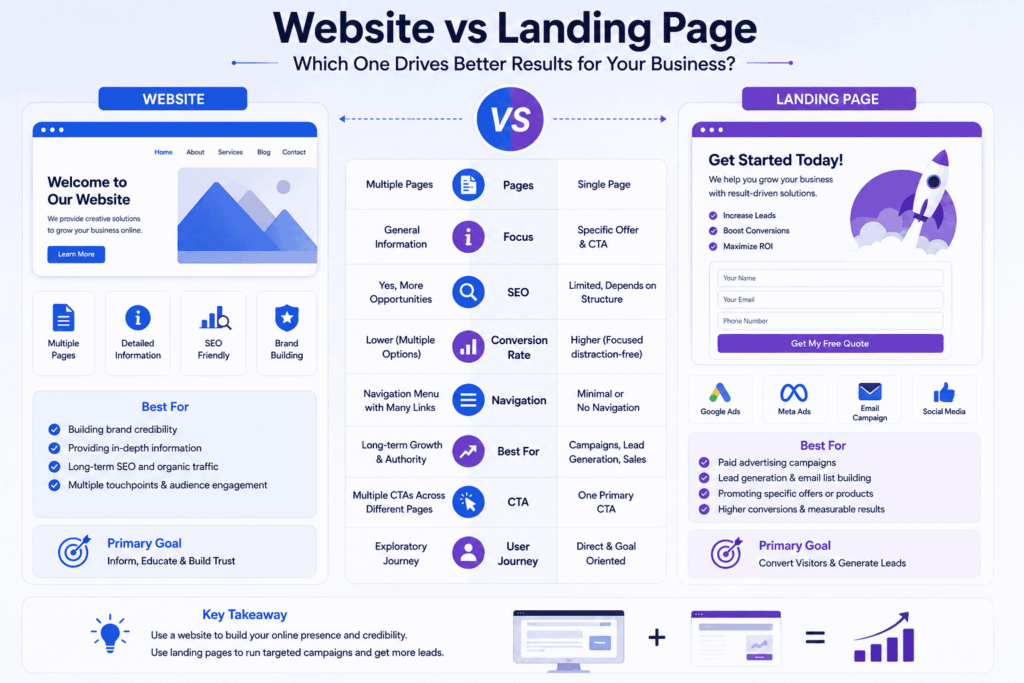
Website vs Landing Page: Key Differences
| Feature | Website | Landing Page |
|---|---|---|
| Purpose | Build brand presence | Generate leads or sales |
| Number of Pages | Multiple | Single |
| Navigation | Full navigation menu | Minimal or none |
| Call-to-Action | Multiple CTAs | One focused CTA |
| SEO Potential | Excellent | Limited |
| Conversion Rate | Moderate | Higher |
| Best For | Long-term growth | Marketing campaigns |
Real-World Example: Website vs Landing Page
Many businesses make the mistake of sending paid advertising traffic directly to their homepage. While a homepage provides complete information about a company, it often includes multiple navigation options that can distract visitors. A dedicated landing page, on the other hand, focuses on a single goal, such as collecting leads, booking consultations, or selling a product. This focused approach usually results in higher conversion rates.
For example, a digital marketing agency can use its website to showcase services, client testimonials, blogs, and company information. However, when running Google Ads or Meta Ads, the agency should direct visitors to a dedicated landing page with a compelling headline, benefits, client reviews, and a lead form. This reduces distractions and increases the chances of generating qualified leads.
When Should You Choose a Website?
A website is the right choice if your goal is to establish a professional online presence and provide detailed information about your business.
Choose a website if you want to:
- Build long-term brand credibility
- Rank on Google through SEO
- Showcase multiple services or products
- Publish blogs and educational content
- Allow customers to explore your business
- Improve online visibility
A website works best for businesses looking to grow consistently over time.
When Should You Use a Landing Page?
Landing pages are ideal when you want visitors to complete one specific action.
Use a landing page if you’re:
- Running Google Ads campaigns
- Running Meta (Facebook & Instagram) Ads
- Promoting a special offer
- Launching a new product or service
- Collecting leads through forms
- Booking appointments or consultations
Because there are fewer distractions, landing pages often convert visitors at a much higher rate than traditional websites.
Which One Generates More Leads?
If your primary goal is lead generation, a landing page generally performs better.
Landing pages are specifically designed to encourage visitors to take one action. Without navigation menus or unnecessary links, users are more likely to complete a form, request a quote, or make a purchase.
However, websites play an equally important role by building trust and helping customers research your business before making a decision.
The most successful businesses don’t choose one over the other—they use both strategically.
Why Using Both Is the Best Strategy
Instead of deciding between a website and a landing page, businesses can benefit from using both together.
Your website serves as your digital headquarters where customers learn about your brand, services, and expertise.
Your landing pages focus on converting traffic from advertising campaigns into qualified leads.
For example:
- Your Google Ads campaign directs users to a dedicated landing page.
- Your website builds credibility through detailed service pages, case studies, and blog content.
- Visitors who want more information can easily explore your website after converting.
This combination creates a seamless customer journey while maximizing your return on investment.
Common Mistakes Businesses Make
Many businesses struggle to generate leads because they make avoidable mistakes.
Some of the most common include:
- Sending paid traffic to the homepage instead of a landing page
- Including too many distractions on landing pages
- Having slow-loading websites
- Using weak or unclear calls-to-action
- Ignoring mobile optimization
- Not tracking conversions
- Forgetting to test different page designs
Avoiding these mistakes can significantly improve your conversion rates.
Best Practices for Higher Conversions
Whether you’re building a website or a landing page, following these best practices can help increase leads:
- Keep your design clean and professional.
- Use compelling headlines.
- Write clear and persuasive copy.
- Include strong call-to-action buttons.
- Add customer testimonials and reviews.
- Optimize page speed.
- Ensure mobile responsiveness.
- Use high-quality visuals.
- Track conversions using analytics.
- Continuously test and improve your pages.
Website vs Landing Page: Which Should You Choose? https://www.youtube.com/results?search_query=HubSpot+What+is+a+Landing+Page
The answer depends on your business goals.
If you want to build your online presence, improve SEO, and establish credibility, invest in a professional website.
If your goal is generating leads quickly through paid advertising or marketing campaigns, create a dedicated landing page.
For the best results, combine both. Use your website to educate and build trust, while using landing pages to convert visitors into customers.
Frequently Asked Questions
Can a landing page replace a website?
A landing page can support a marketing campaign, but it cannot fully replace a website. A website provides comprehensive information about your business and improves long-term SEO.
Which is better for Google Ads?
Landing pages usually perform better because they focus on one conversion goal and reduce distractions.
Do landing pages help with SEO?
Landing pages can rank in search engines, but websites generally provide better long-term SEO opportunities due to their broader content structure.
Can I have multiple landing pages?
Yes. Many businesses create separate landing pages for different products, services, or advertising campaigns to improve conversion rates.
Is a website necessary for a small business?
Yes. A professional website builds trust, increases visibility, and serves as the foundation of your online presence.
Understanding Website vs Landing Page is essential for businesses that want to improve their online marketing strategy and generate more qualified leads. The Website vs Landing Page decision should always be based on your business objectives rather than choosing one option for every situation. While a website helps establish trust, improve search engine rankings, and provide detailed information about your brand, a landing page focuses on guiding visitors toward a single action, such as submitting a form or making a purchase.
The Website vs Landing Page comparison clearly shows that each serves a unique purpose in the customer journey. Businesses that use both strategically often experience better SEO performance, higher conversion rates, and stronger customer engagement. Whether you’re launching a new product, running paid advertising campaigns, or building your brand online, understanding Website vs Landing Page differences will help you make smarter marketing decisions.
Instead of asking whether a Website vs Landing Page is better, the real question is how you can use both together to maximize traffic, conversions, and long-term business growth.
Final Thoughts
Choosing between a website and a landing page isn’t about deciding which one is better—it’s about understanding how each fits into your marketing strategy. A website helps establish credibility, improve search visibility, and showcase your business, while a landing page is designed to convert visitors into leads or customers with a focused message and clear call-to-action.
Businesses that combine a professional website with high-converting landing pages often see the best results. Your website builds trust over time, while your landing pages maximize the performance of paid advertising and marketing campaigns.
At CloudFold Studio, we help businesses create SEO-optimized websites and conversion-focused landing pages that drive measurable growth. Whether you’re looking to generate more leads, improve your online presence, or increase your return on investment, our team can build a solution tailored to your goals.
Ready to grow your business online? Contact CloudFold Studio today and let’s build a digital presence that delivers real results. /contact-us/ https://cloudfoldstudio.com


 Aug 18, 2026