



Outcome-Based Pricing: The Costly Catch in 2026

 Jul 22,2026
  By Muhammad Danish
 Table of Contents
Paying for software used to be simple: pick a plan, pay per seat, done. That model is starting to crack.
More vendors are experimenting with outcome-based pricing — charging customers for results delivered instead of licenses issued. A support platform that only bills when a ticket is resolved. A sales tool that charges per qualified lead, not per rep logged in. A marketing platform that takes a cut of revenue it demonstrably drove. The pitch is compelling: pay for value, not access.
But outcome-based pricing isn’t a free upgrade. It shifts risk, complicates budgeting, and asks buyers to trust a vendor’s measurement of “results” in ways per-seat pricing never required. Before you sign a contract built around this model, it’s worth understanding exactly what you’re agreeing to.
What Outcome-Based Pricing Actually Means
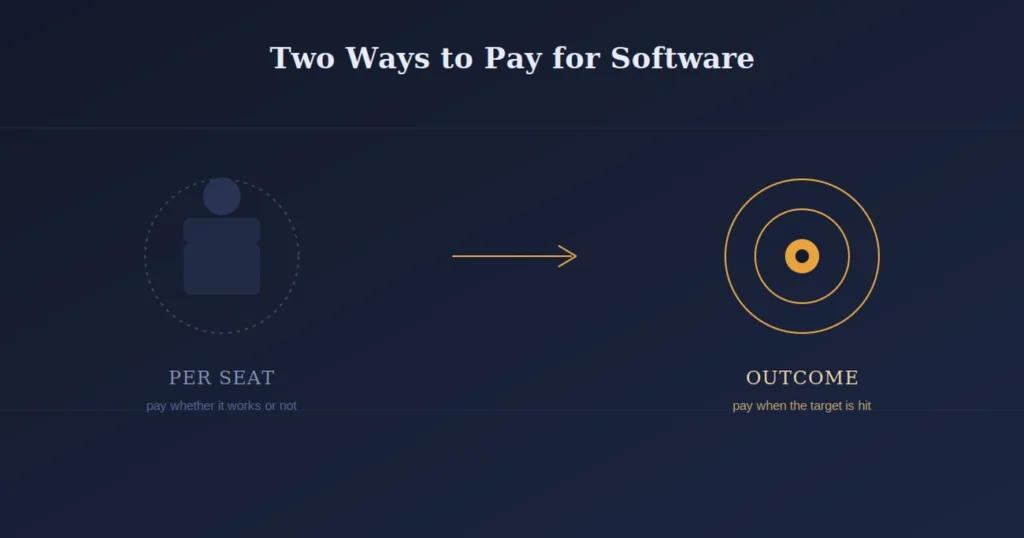
Outcome-based pricing ties what a customer pays to a measurable result rather than to usage, seats, or feature tiers. Instead of “$50 per user per month,” the model looks more like “$2 per resolved support ticket” or “3% of revenue attributed to this campaign.”
This isn’t entirely new. Affiliate marketing has run on commission for decades, and some legal and consulting services have long billed on contingency. Gartner has tracked outcome-based and consumption pricing as a growing share of enterprise software deals in recent years. What’s changed is that SaaS vendors, especially AI-native ones, are applying the same logic to software that used to be sold as a flat subscription. The shift is being driven partly by AI: when a tool can complete a task end-to-end rather than just assist a human doing it, “per seat” stops making sense as a pricing anchor. There’s no seat if there’s no human seated at it.
Outcome-based pricing sits alongside usage-based pricing on a spectrum away from flat-rate seats, but the two aren’t the same thing. Usage-based pricing charges for volume — API calls, storage, messages sent. This model charges for a defined result, regardless of how much work it took to get there.
Why Vendors Are Moving This Direction
For vendors, outcome-based pricing is a sharper sales pitch. Instead of asking a buyer to trust that a tool will be valuable, the vendor absorbs some of that risk itself. “You only pay when it works” removes a common objection at the top of the sales funnel and can shorten procurement cycles considerably.
It also aligns incentives in a way flat subscriptions don’t. A vendor billing per seat gets paid whether or not the product delivers value, which creates little pressure to keep improving outcomes once the contract is signed. A vendor billing on outcomes only grows revenue by making the product work better, which theoretically keeps them accountable long after the deal closes.
There’s also a category-specific driver. As AI agents take on tasks that used to require a human operator, seat-based pricing increasingly measures the wrong thing. A company deploying an AI agent to handle customer support doesn’t want to pay for a “seat” — it wants to pay for tickets closed, especially once AI token costs are already part of the vendor’s own cost structure. This model is a more natural fit for software that acts rather than assists.
What Outcome-Based Pricing Costs You in Practice
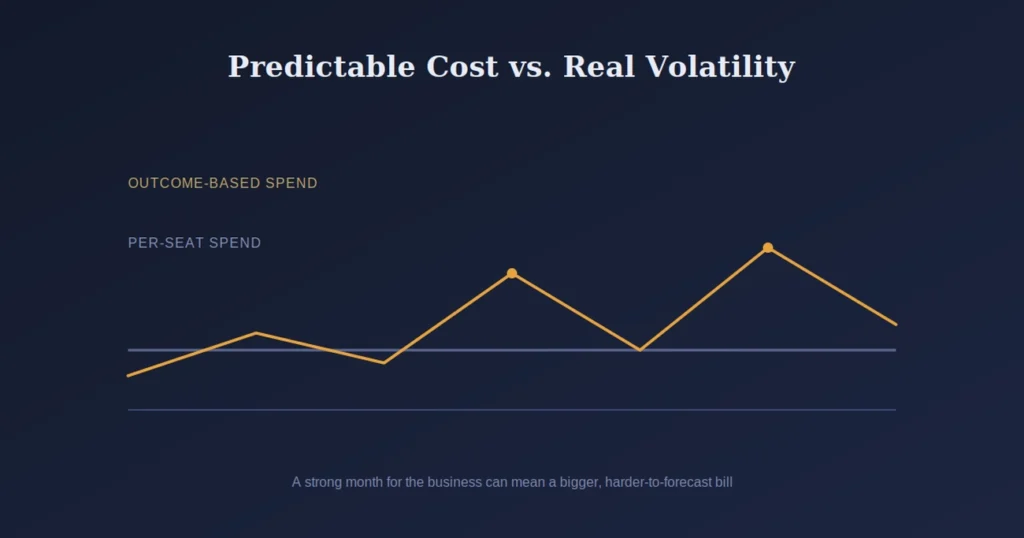
The catch is that outcome-based pricing shifts unpredictability onto the buyer’s budget. Per-seat pricing is easy to forecast: multiply headcount by price, done. This model fluctuates with business performance — a strong month means a bigger bill, which can feel counterintuitive to a finance team trying to plan spend a quarter out.
Attribution is the other sticking point. If a vendor charges per “qualified lead” or per “resolved ticket,” someone has to define what counts. Vague or vendor-favorable definitions of a qualified outcome can quietly inflate a bill in ways a flat subscription never could. Before adopting outcome-based pricing, buyers need contractual clarity on exactly how an outcome is measured, who audits it, and what happens when the two sides disagree on the count.
This model can also concentrate financial exposure. A single high-volume month, whether from real growth or a temporary spike, can produce a bill that’s difficult to explain internally after months of predictable, flat costs. Finance teams accustomed to fixed software costs need new forecasting habits before adopting outcome-based pricing at scale.
Where Outcome-Based Pricing Makes Sense
This approach tends to work best where the outcome is unambiguous and easy to verify. A resolved support ticket, a completed transaction, or a delivered email are relatively clean events to count and agree on. The murkier the definition of “outcome,” the harder the model is to trust.
It also fits categories where the vendor has real control over the result. If a tool’s performance depends heavily on how a customer configures or uses it, tying price to outcomes can create disputes about whose fault a poor result actually is. This model works best when the vendor genuinely owns the mechanism producing the result, not just a supporting role in it.
Early-stage or budget-constrained buyers may find this approach attractive precisely because it lowers the upfront commitment. Rather than paying a flat fee for a tool that may or may not deliver, they only pay once value is demonstrated. That can be a reasonable trade for a smaller company willing to accept some billing unpredictability in exchange for lower fixed costs.
Questions to Ask Before You Sign
Before committing to outcome-based pricing, a few questions are worth asking directly. How exactly is the outcome defined, and in writing, not just in the sales deck? Who has visibility into the underlying data used to calculate what’s owed? Is there a cap or ceiling on total spend if outcomes spike unexpectedly? And can pricing be modeled against last year’s actual business performance, not just a vendor’s example scenario?
Ask for a sample invoice based on your own historical numbers, not a hypothetical case study. This kind of pricing looks very different on paper than it does against your business’s real, sometimes lumpy, month-to-month activity.
It’s also worth asking how disputes get resolved. Flat pricing rarely produces disagreements about what’s owed. Outcome-based pricing introduces a new category of billing conflict: disagreement over whether an outcome actually occurred. A contract that doesn’t address this in advance is asking for friction later.
How Outcome-Based Pricing Compares to the Alternatives
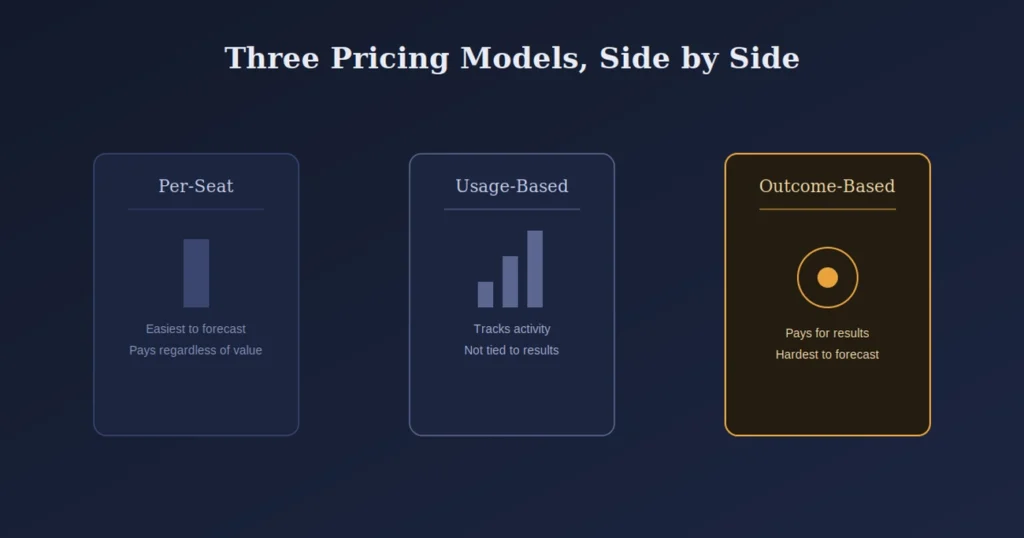
Per-seat pricing remains the easiest model to forecast and the hardest to defend when usage is uneven across a team. Usage-based pricing sits in between, tracking activity but not necessarily results. This approach goes furthest toward aligning cost with value, but it asks the most of both sides: the vendor has to build reliable measurement, and the buyer has to trust it. None of these models is universally better. The right choice depends on how predictable your usage is, how much you trust a vendor’s outcome definitions, and how much billing volatility your finance team can absorb without disruption. Many companies end up running a mix — flat pricing for core seats, with outcome-based pricing layered on top for specific high-leverage use cases like AI-driven support or lead generation. Mixing models thoughtfully is different from SaaS sprawl, where tools pile up without anyone tracking what each one is actually costing.
Is Your Business Ready for Outcome-Based Pricing?
This model isn’t a trend to adopt just because it’s gaining attention. It’s a genuine shift in how risk is shared between vendor and customer, and it rewards businesses that go in with clear expectations and contractual guardrails. Rushing into it without defining outcomes precisely is how a promising pricing model turns into a billing dispute six months later.
The businesses getting the most out of this model tend to be the ones asking hard questions upfront: how outcomes are defined, how they’re audited, and what happens when the numbers are disputed. Get that groundwork right, and the approach can genuinely align what you pay with what you get. Skip it, and you’re just trading one set of pricing headaches for another.
At Cloud Fold Studio, we help SaaS teams evaluate pricing models against how their business actually runs, not just how a vendor’s pitch deck says it should. If you’re weighing this approach against a usage-based or per-seat structure, we’re happy to help you model it against your own numbers before you sign anything.


 Aug 18, 2026