



AI as a Feature Is Dead: 7 Signs You’re AI-Native

 Jul 14,2026
  By Muhammad Danish
 Every SaaS product on the market claims to be “AI-powered” now. A chatbot bolted onto a support tab. A summarize button dropped into a dashboard. A single autocomplete field wearing the label like a badge. This is AI as a feature, and it’s already running out of road.
The products winning right now aren’t the ones with the most AI checkboxes ticked. They’re the ones where AI isn’t a checkbox at all — it’s the architecture. That distinction is quietly splitting the SaaS market into two categories: tools that bolted something on, and tools that were rebuilt around it.
This article breaks down why the bolt-on era is ending, what AI-native actually means in practice, and how to tell which category a product — including your own — really belongs to.
Why “AI as a Feature” Worked, For a While
Treating AI as a feature made sense in 2023. Large language models were new enough that simply having one in the product was a differentiator. Adding a “summarize this” button or a chat widget was fast, low-risk, and gave sales teams something new to demo. It didn’t require touching the core data model, the permissions system, or the workflows customers already relied on. For a market still getting used to generative AI, that was often the right call. Bolting on a feature let teams test demand without betting the roadmap on a technology that was still moving fast.
But that phase had a shelf life built into it. Once every competitor has the same bolt-on chatbot, it stops being a differentiator and starts being table stakes — a checkbox customers expect rather than a reason to choose one tool over another.
Where AI as a Feature Starts to Break Down
The cracks show up in predictable places once AI as a feature gets pushed past its original scope.
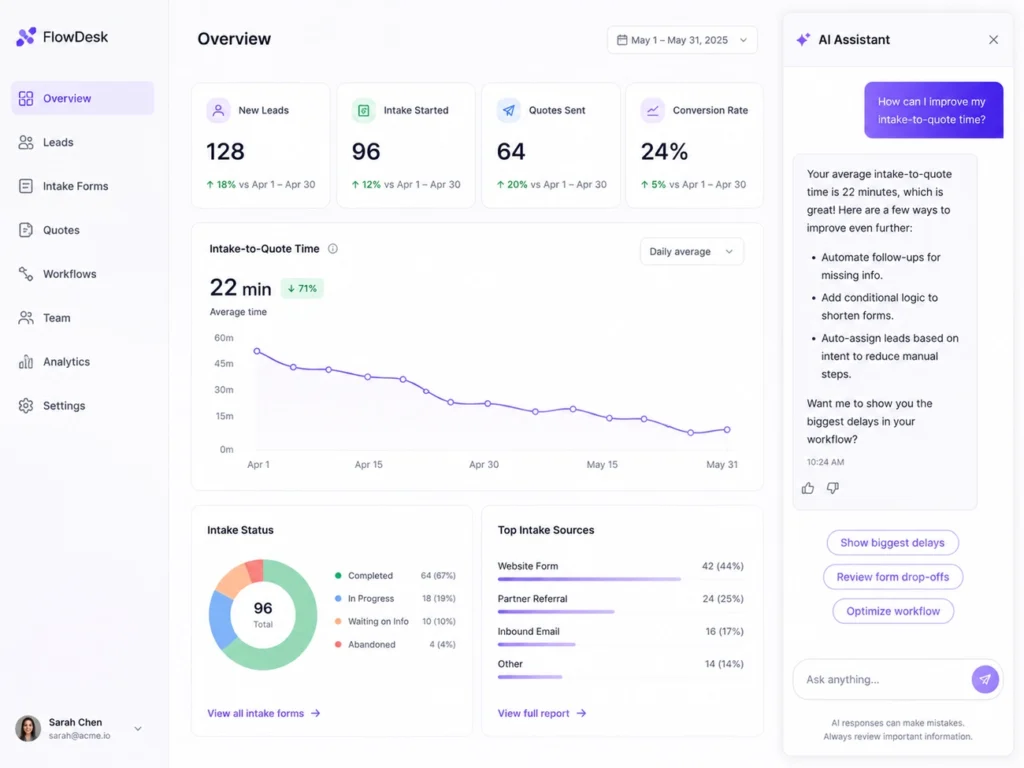
The AI functionality usually lives in its own corner of the product, disconnected from the actual workflow. A user has to stop what they’re doing, open a separate panel, paste in context by hand, and copy the output back into the place they were actually working. Every one of those steps is friction, and friction is exactly what AI was supposed to remove.
There’s also a data problem. A bolted-on feature typically only sees whatever the user manually feeds it, not the full context sitting in the product already — the account history, the related records, the permissions that should shape what the AI is even allowed to suggest. Without that context, the output is generic, and generic AI output is easy to ignore.
Cost is the other place AI as a feature breaks down fast. Teams that treated it as an add-on often didn’t design for the ongoing expense of running it. Token usage scales with adoption, and without architecture built around that reality, a feature that looked cheap in a demo can become a real line item once real usage kicks in. We’ve covered this in more depth in our guide to building a responsible AI governance framework, which gets into how cost and oversight need to be designed in from the start rather than patched on later.
What “AI-Native” Means, Compared to AI as a Feature
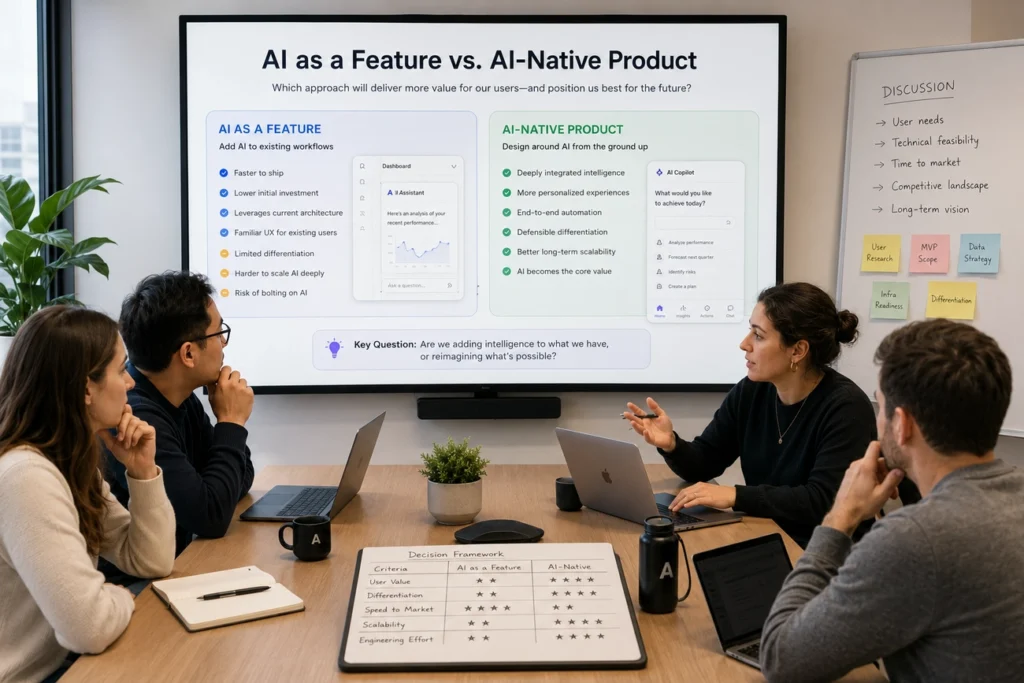
AI-native isn’t a marketing term for “has more AI features” — it’s the opposite of AI as a feature as a design philosophy. It describes a different starting point for how the product is built. In an AI-native product, the model isn’t a widget sitting next to the workflow — it’s part of the workflow. Suggestions appear where the work already happens, informed by the data the product already has, without the user needing to explain their own context back to the system. That difference shows up in a few consistent ways:
Context is structural, not manual. An AI-native tool has access to the relevant account, document, and workflow data by design, because the system was built to route that context to the model automatically. A product still treating AI as a feature usually can’t do this without significant reengineering, because it was never wired into the data layer in the first place.
Cost and governance are part of the architecture, not an afterthought. Teams building AI-native products plan for token spend, rate limits, and audit trails from day one, the same way they’d plan for database scaling. Our data privacy checklist for cloud tools covers what that kind of groundwork looks like in practice for regulated SaaS environments.
Trust is engineered in, not assumed. AI-native products tend to make it clear what the model can see, what it can act on, and where a human needs to step in. That transparency is a design decision, not a disclaimer buried in a settings page. It’s part of why enterprise buyers increasingly ask about this directly — a shift we’ve written about in why enterprise trust in AI agents is becoming a buying criterion.
Why This Distinction Matters More in 2026
The gap between AI as a feature and AI-native design used to be mostly aesthetic. Now it’s becoming a real product and cost problem, for two reasons.
First, buyers have gotten more sophisticated. Procurement teams evaluating SaaS tools now ask pointed questions about where AI output comes from, what data it touches, and how it’s governed. A bolt-on feature with vague answers to those questions is a harder sell than it was a year ago, especially in regulated industries where those answers need to be precise.
Second, the economics have shifted. Token costs and usage patterns are no longer an afterthought line item — they’re a planning input, echoing the kind of ongoing infrastructure spend a16z has documented in AI compute economics. Products that still treat AI as a feature rather than infrastructure are discovering that it’s quietly becoming one of their largest expenses, with no clean way to control it because it was never designed to be measured or throttled in the first place.
How to Tell Which Category a Product Actually Falls Into
The label a company uses in its marketing doesn’t settle this — the architecture does. A few honest questions tend to separate AI as a feature from AI-native design fairly quickly.
Does the AI functionality require the user to leave their normal workflow to use it, or does it appear inside the task they’re already doing? Does the model have access to relevant account and workflow context automatically, or does someone have to type that context in by hand every time?
Is there a clear answer for what the AI can see, what it’s allowed to act on, and how usage is being tracked and controlled? And critically, was cost management for AI usage designed into the product, or is it something the team is scrambling to bolt on after the fact?
A product that struggles to answer these clearly is very likely treating AI as a feature, whatever the marketing copy says.
Moving From AI as a Feature to Built-In
None of this means every company needs to rip out its roadmap and start over. Plenty of genuinely useful AI functionality started as a bolt-on and matured from there. The real question is whether a team is treating that as a stopping point or a starting point.
Moving away from AI as a feature toward something closer to AI-native usually starts small: getting the model real access to the context it needs instead of relying on users to supply it manually, building basic cost and usage tracking before it becomes an unpleasant surprise, and being explicit with customers about what the AI can and can’t see. None of that requires a full rebuild on day one, but it does require treating AI as core infrastructure rather than a checkbox next to the pricing table.
The SaaS teams that get ahead in 2026 won’t be the ones with the most AI features listed on their homepage. They’ll be the ones where AI stopped being a feature at all — because it became part of how the product simply works.
Not sure whether your product’s AI functionality is a feature or genuinely native to how it works? At Cloud Fold Studio, we help SaaS teams evaluate their AI architecture, manage token costs, and build the kind of governance enterprise buyers now expect. Reach out for a free assessment of where your AI stack currently stands.


 Aug 18, 2026