



How Compliance-Ready SaaS Saves Time in Regulated Industries

 Jul 13,2026
  By Muhammad Danish
 Compliance shouldn’t cost you your afternoon. For most regulated teams, it does anyway.
Table of Contents
What “Compliance-Ready SaaS” Actually Means • The Time Cost of Manual Compliance Work • How Compliance-Ready SaaS Changes the Math • The Numbers Behind the Time Savings • The Audit-Readiness Advantage • The Human Cost of Compliance Busywork • A Familiar Pattern in Regulated Teams • How to Move to Compliance-Ready SaaS the Smart Way
For teams in healthcare, finance, insurance, and other regulated industries, compliance isn’t a once-a-year event. It’s a constant background tax on every workflow — screenshots for audit trails, manually logged approvals, spreadsheets tracking who accessed what and when. Compliance-ready SaaS exists precisely to remove that tax, but a surprising number of regulated businesses still run compliance manually, layered on top of tools that were never built for it.
At Cloud Fold Studio, we’ve helped regulated teams migrate away from that exact setup. The pattern is consistent: once compliance tracking is built into the software itself rather than bolted on afterward, hours come back into the week almost immediately — and audits stop being a fire drill.
This post breaks down where those hours actually go today, what compliance-ready SaaS changes structurally, and what regulated teams tend to do differently once they make the switch.
The Time Cost of Manual Compliance Work
Manual compliance work rarely looks dramatic day to day. It looks like a compliance officer exporting logs by hand, a project manager screenshotting approval chains for an upcoming audit, or an analyst reconciling access records across three disconnected systems because none of them talk to each other.
None of this is a single expensive event. It’s small, repeated friction — twenty minutes here logging a change, an hour there preparing an audit binder — that adds up across every employee touching regulated data. Multiply that across a team of fifty, every week of the year, and it’s easily the equivalent of a full-time role spent entirely on paperwork that compliance-ready SaaS would handle automatically.
How Compliance-Ready SaaS Changes the Math
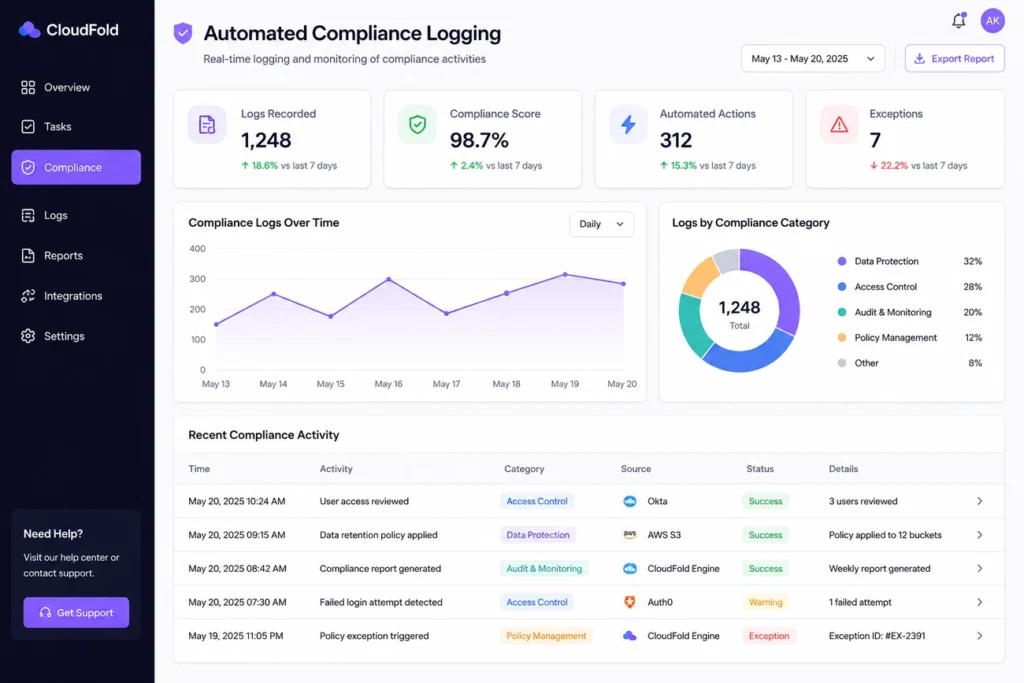
Compliance-ready SaaS builds the audit trail into the workflow instead of requiring someone to reconstruct it afterward. Every access, edit, and approval is logged automatically, timestamped, and stored in a format regulators actually expect — no separate spreadsheet, no manual export, no scramble the week before an audit.
This isn’t just about saving time on logging. It changes what happens when a regulator, auditor, or enterprise customer asks for evidence. Instead of days spent assembling records from scattered sources, a compliance-ready platform can produce that evidence in minutes, because the trail already exists in a structured, exportable form. Teams that have adopted this kind of governance-first infrastructure consistently report faster audit cycles and fewer last-minute scrambles.
The Numbers Behind the Time Savings
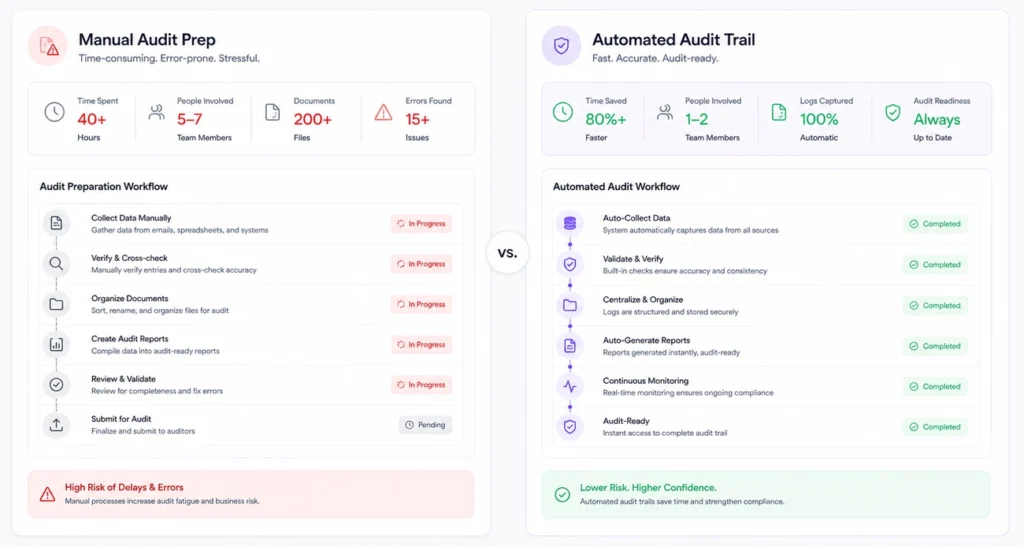
It helps to see this in concrete terms. Manual compliance documentation, across data entry, reconciliation, and audit prep combined, is estimated to consume dozens of hours per employee per quarter in regulated industries. A meaningful share of compliance teams report they could reclaim six or more hours per employee, per week, simply by moving repetitive documentation into automated systems.
Regulated businesses that have adopted compliance-ready SaaS also tend to report shorter audit cycles and fewer follow-up requests from auditors, since the evidence is already organized the way examiners expect it. Independent ROI research on compliance automation puts audit-prep time reductions in the 60-80% range once evidence collection moves from manual screenshots to automated systems — a gap most regulated teams don’t realize exists until they see it closed. None of this requires enterprise-scale budgets. It requires software that was designed with compliance as a first-class feature rather than an afterthought.
The Audit-Readiness Advantage
…When the audit trail lives inside the software rather than in someone’s memory or inbox, the business isn’t just faster to respond — it’s demonstrably more trustworthy to the customers and regulators evaluating it.
There’s a compounding effect here too. The first audit under a compliance-ready system is faster because the records already exist. But every subsequent audit gets easier still, because the historical trail keeps building automatically instead of resetting to zero each time someone leaves the team or a process changes hands. Institutional knowledge stops living in one compliance officer’s head and starts living in the system itself, which matters enormously when that person eventually moves on or takes vacation during audit season.
This also changes how sales conversations go for regulated businesses selling into other regulated industries. Enterprise buyers now routinely ask for compliance documentation before signing, and a vendor who can produce it in an afternoon looks fundamentally more credible than one who needs two weeks to assemble it from scratch. That speed becomes a competitive advantage that has nothing to do with the product itself and everything to do with how compliance is handled behind the scenes.

The Human Cost of Compliance Busywork
…There’s also a trust dimension: enterprise customers evaluating a regulated vendor increasingly ask how AI agents and automated systems are governed before signing a contract, and teams without clear answers lose deals to competitors who built that trust into their systems from the start.
This human cost tends to show up first in the most experienced people on the team, not the newest. Junior staff often don’t know any other way of working, but the compliance veterans who remember what manual audit prep looked like five years ago are usually the first to recognize when a better system exists elsewhere — and the first to leave for it if their current employer keeps delaying the switch.
A Familiar Pattern in Regulated Teams
A common scenario looks like this: a growing healthcare or fintech company starts with a handful of tools and manual tracking that works fine at a small scale. As the team grows and regulatory scrutiny increases, the manual process starts cracking — records get missed, audit prep stretches from days into weeks, and compliance staff spend more time reconstructing history than managing risk going forward.
Nobody chose this outcome directly. Each quarter, switching to compliance-ready SaaS felt like something that could wait until after the current audit. By the time leadership finally makes the switch, the migration is bigger and more disruptive than it would have been eighteen months earlier — a pattern we see across nearly every regulated team we work with.
How to Move to Compliance-Ready SaaS the Smart Way
There’s rarely a perfect moment to make this switch, and there will always be a reason it feels easier to wait until after the next audit. Teams that benefit most don’t wait for ideal timing — they treat compliance infrastructure as ongoing maintenance rather than a someday project.
A few practical starting points:
Start with the workflow generating the most manual documentation, not the flashiest tool on the market.
Migrate one compliance-heavy process this quarter rather than planning a full platform overhaul that never gets approved.
Set a recurring review of where audit trails still rely on manual work, so gaps get caught before an actual audit does.
Treat compliance tooling as a living system that evolves with regulation, not a one-time purchase you set and forget.
A simple test: if your next audit request would trigger a week of manual document hunting, the cost of staying manual is almost certainly higher than the cost of switching to compliance-ready SaaS now.
Not sure where your compliance stack stands? At Cloud Fold Studio, we help regulated teams move to compliance-ready SaaS without the overwhelm — whether that means automated audit trails, governed AI workflows, or infrastructure that holds up under regulatory scrutiny. Reach out for a free assessment of where your current setup might be costing you more time than you think.


 Aug 18, 2026