



How to Budget for AI Token Costs Without Blowing Your SaaS Spend

 Jul 07,2026
  By Muhammad Danish
 Table of Contents
Nobody budgets for AI token costs until the invoice forces them to.
What “AI Token Costs” Actually MeanThe Direct Financial Risk of Ignoring Your AI BillHow Token Spend Compounds as You ScaleThe Real Numbers Behind AI Token CostsBuilding a Realistic AI Budget FrameworkCommon Mistakes That Blow Up Your AI BillHow to Keep Token Spend Under Control Long-Term
Budgeting for AI token costs is one of those line items that looks small in a demo and enormous three months later. “We’ll start with the free tier.” “Usage will probably stay flat.” “We can throttle it if the bill gets high.” Each assumption sounds reasonable alone. Together, they explain why so many SaaS teams get blindsided by a bill that’s quietly grown five or ten times larger than what they scoped.
At Cloud Fold Studio, we’ve watched this pattern repeat across dozens of AI-enabled products. The teams that get burned hardest by AI token costs are rarely the ones using the most advanced models. They’re the ones who never built a budget for token usage, so there was nothing to compare the real bill against until it was too late to course-correct cheaply.
This article breaks down where AI token costs actually come from, what a sane budgeting process looks like, and what teams that get this right tend to do differently. If you’re still weighing whether to invest in AI agents in business processes at all, this is the budgeting piece that should come right after that decision.
What “AI Token Costs” Actually Mean
AI token costs are the per-request charges you pay every time your product sends text to, or receives text from, a language model. Every prompt, every document your AI feature reads, and every reply it generates gets broken into tokens, and each one has a price attached.
The tricky part is that token usage rarely scales the way founders picture it upfront. A single customer asking one question isn’t the problem. The problem is a feature that quietly sends a full document, a chat history, and a system prompt with every single call, multiplying the token count of what looked like a simple interaction.
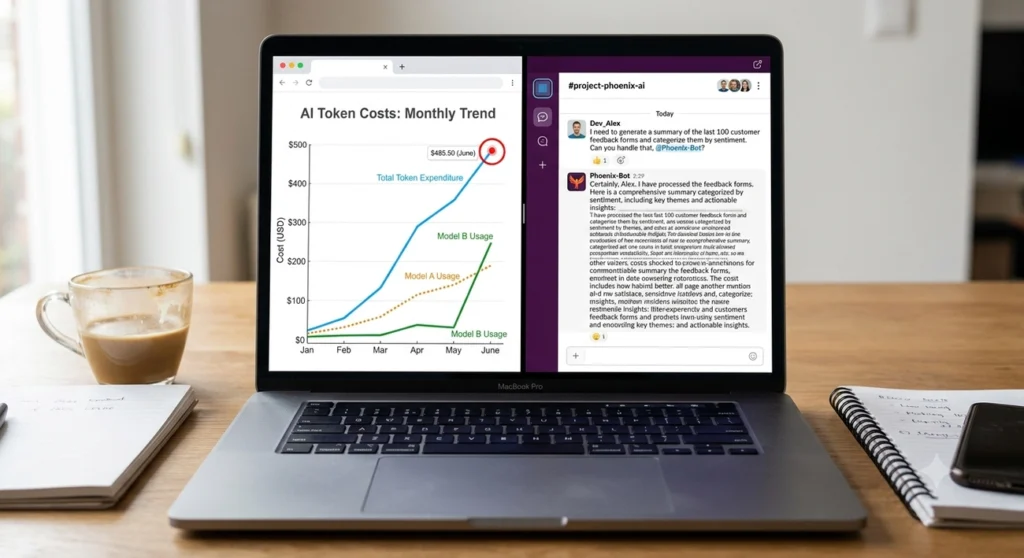
What makes AI token costs so easy to underestimate is that there’s rarely one dramatic spike that forces the issue. Nothing breaks outright. The bill just creeps up a little each billing cycle, tucked inside a vendor invoice nobody reads line by line until finance asks why the “AI infrastructure” category tripled.
The Direct Financial Risk of Ignoring Your AI Bill
The financial risk of ignoring your token spend is bigger than most SaaS teams expect. A feature built around long context windows, verbose system prompts, or repeated calls to reprocess the same data can burn through thousands of dollars in usage before anyone notices the pattern.
It’s not just the obvious features either. Background jobs that summarize records, retry logic that silently reruns failed calls, and debug logging that pipes full prompts into a monitoring tool all add to the same bill. Every unmonitored dollar of AI usage is spend that never shows up as a clean, single line item.
None of these costs arrive as one invoice you can point to, which is why they’re so easy to underestimate. A bloated prompt here, an unnecessary retry there, a chat history that never gets trimmed, none of it looks alarming alone. Added up over a quarter, it’s often the equivalent of an extra engineering hire spent on inefficiency rather than product — the same slow-drain pattern we’ve written about in the cost of delaying tech upgrades.

How Token Spend Compounds as You Scale
Token sprawl is what happens when nobody owns AI token costs as the product grows. A feature that made sense at ten users becomes a very different cost problem at ten thousand. A prompt template that includes a full customer record works fine in a demo, then quietly multiplies once every customer record is several times longer in production.
Research on usage-based cloud spend shows that companies with clear cost visibility catch scaling problems early, while teams flying blind on their token spend typically discover the issue only after finance flags an anomaly. The longer the gap between usage and monitoring goes unaddressed, the more expensive and disruptive it becomes to fix.
This is why teams that ignore their token spend the longest often face the biggest, most disruptive rewrites instead of a series of small optimizations. Letting inefficient prompts and unbounded context windows run for months rather than catching them early tends to turn a quick prompt fix into a full feature redesign.
The Real Numbers Behind AI Token Costs
It helps to see the scale of this in concrete terms. A single request with a bloated system prompt and full conversation history can easily use ten times more tokens than the same request built with a trimmed, purpose-built prompt. Many SaaS teams report that a large share of their monthly AI bill comes from just a handful of inefficient endpoints, not from overall usage growth.
None of these numbers require cutting-edge optimization or a dedicated MLOps team. They’re about ordinary inefficiencies, like sending more context than a model needs, that most product teams quietly pay for every day, simply because nobody has sat down to budget AI token costs across the whole product.

Building a Realistic AI Budget Framework
A useful token spend budget starts with a per-feature estimate, not a company-wide guess. Break your product down by AI-powered feature, estimate average tokens per request for each one, and multiply by expected usage volume to get a per-feature monthly range.
From there, add a buffer. Usage-based costs behave more like a utility bill than a subscription: they move with customer behavior, not your release calendar. A buffer of thirty to fifty percent above your estimate gives you room to absorb spikes without triggering a budget crisis the first time a feature takes off.
Finally, set a review cadence. Monthly is usually enough for early-stage products; weekly makes sense once a feature is customer-facing at scale. The goal isn’t perfect prediction, it’s catching a cost curve bending the wrong way before it becomes a quarter-ending surprise.
Common Mistakes That Blow Up Your AI Bill
The most common mistake is sending more context than a model needs. Full documents, entire chat histories, and verbose system prompts all inflate AI token costs without necessarily improving output quality. Trimming context to what’s actually relevant is usually the fastest, cheapest fix available.
The second mistake is unbounded retries. A call that fails silently and retries three times multiplies your token spend by three without anyone noticing, since the failure itself never surfaces in a dashboard that only tracks successful responses.
The third mistake is treating model choice as a one-time decision. Using the most expensive model for every task, including simple classification or short replies a smaller model could handle just as well, is one of the quietest ways token spend creeps past budget.
How to Keep Token Spend Under Control Long-Term
There’s rarely a perfect moment to build proper cost monitoring for AI token costs. There will always be a reason it feels easier to ship the feature first and worry about the bill later. But teams that manage this well don’t treat cost tracking as a one-time audit, they treat it as ongoing maintenance.
A few practical starting points that tend to work well for teams ready to get ahead of this:
Start with your highest-volume AI feature, not the newest one. That’s usually where the biggest savings are hiding.
Set a monthly token budget per feature, so a spike gets flagged before it becomes a quarter-ending surprise.
Cap context length and retry counts at the code level, not just in a dashboard alert.
Match model choice to task complexity, saving the most expensive model calls for the work that actually needs them.
A simple test: if you can’t say roughly what your top three AI features cost per thousand users this month, the risk of an unpleasant surprise next quarter is almost certainly higher than the effort of finding out now.
Not sure where your product stands?
At Cloud Fold Studio, we help SaaS teams get ahead of AI token costs before they blow up the budget, whether that’s through our AI integration services, auditing prompt efficiency, right-sizing model choice, or building the monitoring that catches problems early. Reach out for a free assessment of where your current AI usage might be costing you more than you think.
Sources: OpenAI Pricing, Anthropic Pricing


 Aug 18, 2026